
Key Takeaways
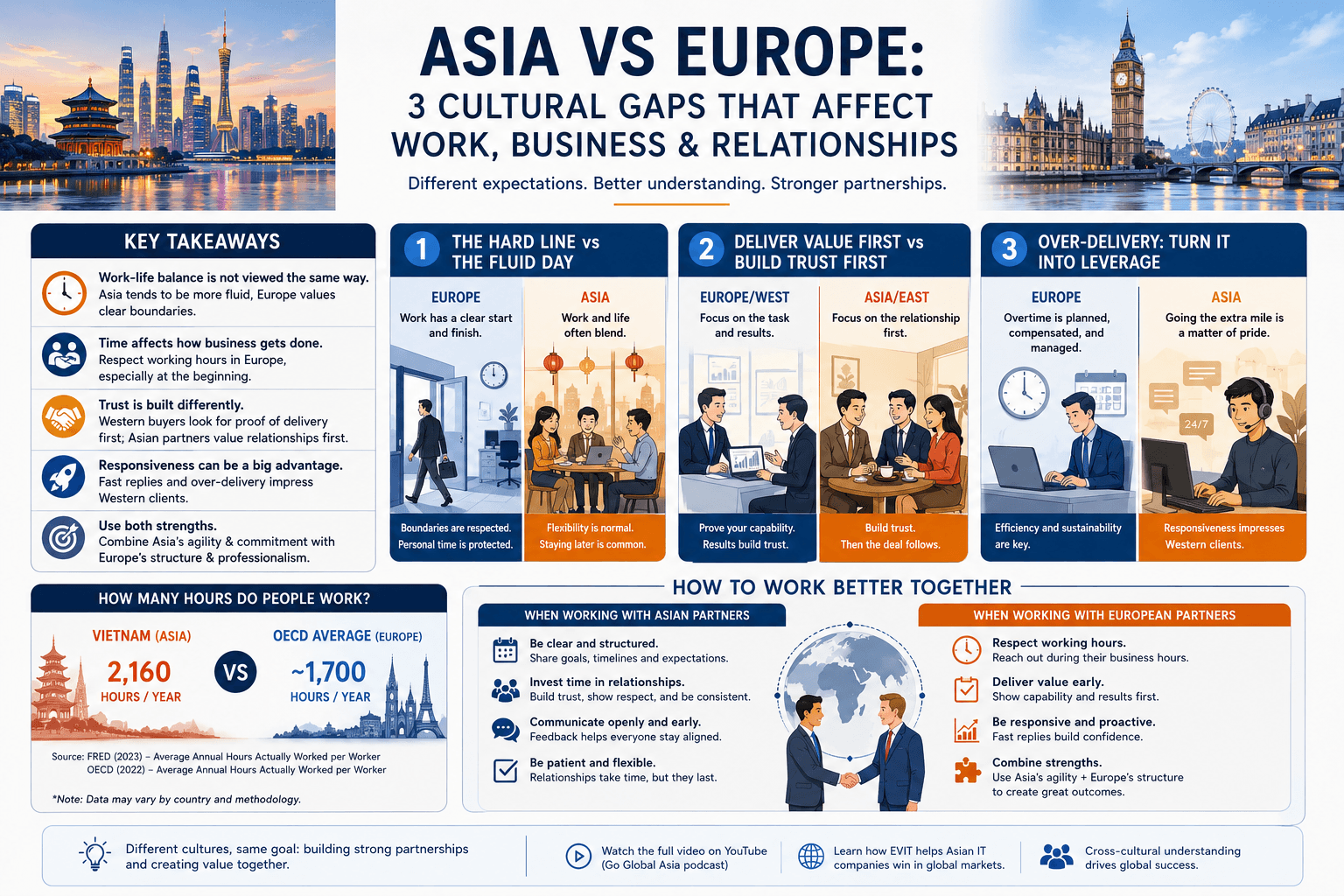
- Work-life balance is not viewed the same way everywhere. Europe often has clearer boundaries between work and personal time, while many Asian workplaces allow more flexibility.
- Time affects business communication. Asian IT companies selling to Europe should respect local working hours, especially when starting a new client relationship.
- Trust can be built differently. Western buyers often look for proof of delivery and business value early, while Asian business environments may place more weight on relationships first.
- Responsiveness can become a competitive advantage. Fast communication and strong delivery can help Asian IT vendors stand out with Western clients.
- The goal is not to choose one culture over another. Companies that understand both approaches can adapt their sales and collaboration style more effectively
Why Is Work-Life Balance So Different in Asia vs Europe?
Work-life balance in Asia and Europe often rests on different assumptions.
In many European business environments, work and personal life are separated by a relatively clear boundary. Working hours are defined, personal time is protected, and communication outside working hours may be considered intrusive.
Across much of Asia, the boundary can be more fluid. Work, relationships, social activities, and personal life may overlap more naturally. Employees may stay later, communicate outside standard working hours, or spend time with colleagues after work without seeing this as a significant disruption to personal life.
These differences matter in international business. They shape how people view time, trust, commitment, and responsiveness.
The difference is also visible in working-hour data.
- Vietnamese workers averaged roughly 2,160 hours per year in 2023, compared with an OECD average of around 1,700 hours (Source: FRED)
- Approximately 1,726 hours for EU full-time workers in 2022. Germany was among the lowest at about 1,332 hours (Source: OECD).
The gap can therefore reach several hundred hours per year – enough to shape fundamentally different expectations about work and time.
For companies operating between Asia and Europe, three cultural gaps are particularly relevant.
Gap 1 – Working hours & boudaries

In Ireland and other European countries, a standard working schedule often has a very clear meaning.
A typical 9-to-5 schedule is not simply a guideline. As the working day approaches its end, employees may begin preparing to leave, and once working hours finish, the workplace can empty quickly.
This reflects a broader European approach: work and personal life are often treated as separate areas with clear boundaries.
In many Asian workplaces, the situation can be more flexible.
Teams may change their working hours depending on the day’s responsibilities. colleagues may socialise together after work, and employees may voluntarily remain at the office longer. In some Vietnamese offices, for example, teams may order dinner, eat together, and then continue working – not necessarily because overtime has been required, but because staying longer is considered normal or convenient.
Neither approach is inherently better. They simply create different expectations.
Business lesson
For an Asian company approaching Western clients, respecting the client’s working hours can make a meaningful difference – especially early in the relationship.
A message sent at 9:00 pm may feel completely normal in Hanoi but could feel intrusive to a client in Dublin or another European market.
Practical rule: When building a new relationship with a Western client, communicate primarily within their working hours unless there is an established reason to do otherwise.
Gap 2 – Trust & tionships

Another difference appears in how business relationships develop.
In many European business environments, early collaboration tends to be practical and task-focused. The priority is often straightforward:
Understand the requirement → do the work → demonstrate the result.
There may be less emphasis on getting to know the other person’s personal interests before collaboration begins.
Research on cross-cultural trust also suggests that Western managers may be more likely to initially assume trust, while East Asian managers can place greater emphasis on assessing competence before extending trust.
In Vietnam and other parts of Asia, relationships can play a much stronger role in business development.
Before a deal is finalised, there may be more time spent meeting in person, sharing meals, socialising, or developing a personal connection. The objective is not simply to complete a transaction but to establish confidence in the people behind it.
For international IT companies, this difference can create a common misunderstanding.
An Asian vendor may spend significant time trying to build a relationship with a Western prospect before demonstrating enough concrete business value.
The Western prospect, meanwhile, may simply be waiting to see whether the vendor can execute.
Business lesson
For Asian IT companies selling to Western clients, a stronger approach is often:
Deliver value first. Build the relationship on top of it.
Demonstrate expertise, responsiveness, and execution early. Once the client sees that the company can deliver, relationship-building becomes much easier.
The strongest combination is not trust instead of delivery.
It is: High delivery + high trust.
Gap 3 – Turn Over-Delivery Into Leverage
A third difference concerns responsiveness and effort.
Across many Asian business environments, staying flexible, responding quickly, and going beyond the original requirement can be seen as part of professional responsibility or pride.
In many European environments, working beyond agreed hours may instead be associated with overtime, compensation, or a clear contractual expectation.
Again, neither approach is universally better.
But for an Asian IT company selling internationally, this difference can become a competitive advantage when managed correctly.
Western clients can be highly impressed by responsiveness – especially when a team demonstrates that responsiveness consistently during the early stages of a project.
A common reaction from US and European clients working with highly responsive Asian teams is surprise at how quickly team members answer questions or handle issues, even outside conventional hours.
That responsiveness can create an important perception:
“This team really cares about getting the job done.”
Business lesson
If fast response times and over-delivery are already part of an Asian team’s working culture, make those strengths visible early.
The first few weeks of a project are particularly important. Strong execution and responsiveness can turn initial curiosity into confidence and confidence into long-term collaboration.
The key is not simply to work more.
The key is to make the value of that extra effort visible to the client.
Asia vs Europe: The Work-Life Balance Cheat Sheet
| Dimension | Europe / West | Asia / East |
|---|---|---|
| Boundaries | Clear line – work often ends at a defined time | More fluid – work and life can overlap |
| Colleagues | Often primarily professional relationships | Work and social relationships may overlap more |
| Trust | Often developed through demonstrated delivery | Relationship-building can come before the deal |
| Overtime | Often linked to compensation or formal expectations | May be viewed as responsibility, flexibility, or pride |
| First move with a new partner | Deliver value and prove execution | Build the relationship and establish trust |
| Best outreach time | Within working hours | More flexible depending on the relationship |
Key Lessons: How to Profit From the East-West Gap
| If you are… | Do this |
| An Asian vendor selling to the West | Contact clients within working hours; demonstrate value and execution early; showcase responsiveness and over-delivery |
| A Western firm working with Asian teams | Expect more flexible working patterns and potentially faster responses; invest in relationship-building to strengthen collaboration |
| Building a cross-border company | Design the business to operate between East and West – use each culture’s strengths where they fit |
| Starting a new collaboration | Lead with strong delivery, then build deeper trust; the combination creates the strongest long-term relationships |
Understanding how East and West approach work, time, trust, and responsiveness can help international companies avoid unnecessary friction and design stronger commercial relationships.
The goal is not to decide which culture has the “right” approach.
The goal is to understand the difference and use it strategically.
FAQs: Work-Life Balance in Asia vs Europe
How is work-life balance different in Asia vs Europe?
European workplaces often maintain a clearer boundary between work and personal life, with defined working hours and stronger expectations around personal time. In many Asian workplaces, work, relationships, and personal life can overlap more naturally, creating more flexibility around working hours.
Do people in Asia work more hours than in Europe?
On average, yes. Vietnamese workers average roughly 2,160 hours per year, compared with around 1,700 across the OECD and approximately 1,726 for EU full-time workers. The difference can therefore exceed 400 hours and, compared with some European countries, reach more than 800 hours annually.
Should I build the relationship or deliver value first?
It depends on the counterpart and market. With Western clients, demonstrating value and execution early is often the stronger starting point. With Asian partners, investing in the relationship early can be particularly important because trust may play a larger role before a deal is established.
When should I contact a Western business client?
Within their working hours, particularly when the relationship is new. A late-night message that may feel normal in parts of Asia can feel intrusive to a Western client who maintains a stronger separation between work and personal time.
How can an Asian IT company stand out with Western clients?
Make strong execution, responsiveness, and willingness to go beyond expectations visible during the early stages of a project. When these behaviours are consistent and valuable to the client, they can become a meaningful competitive advantage.