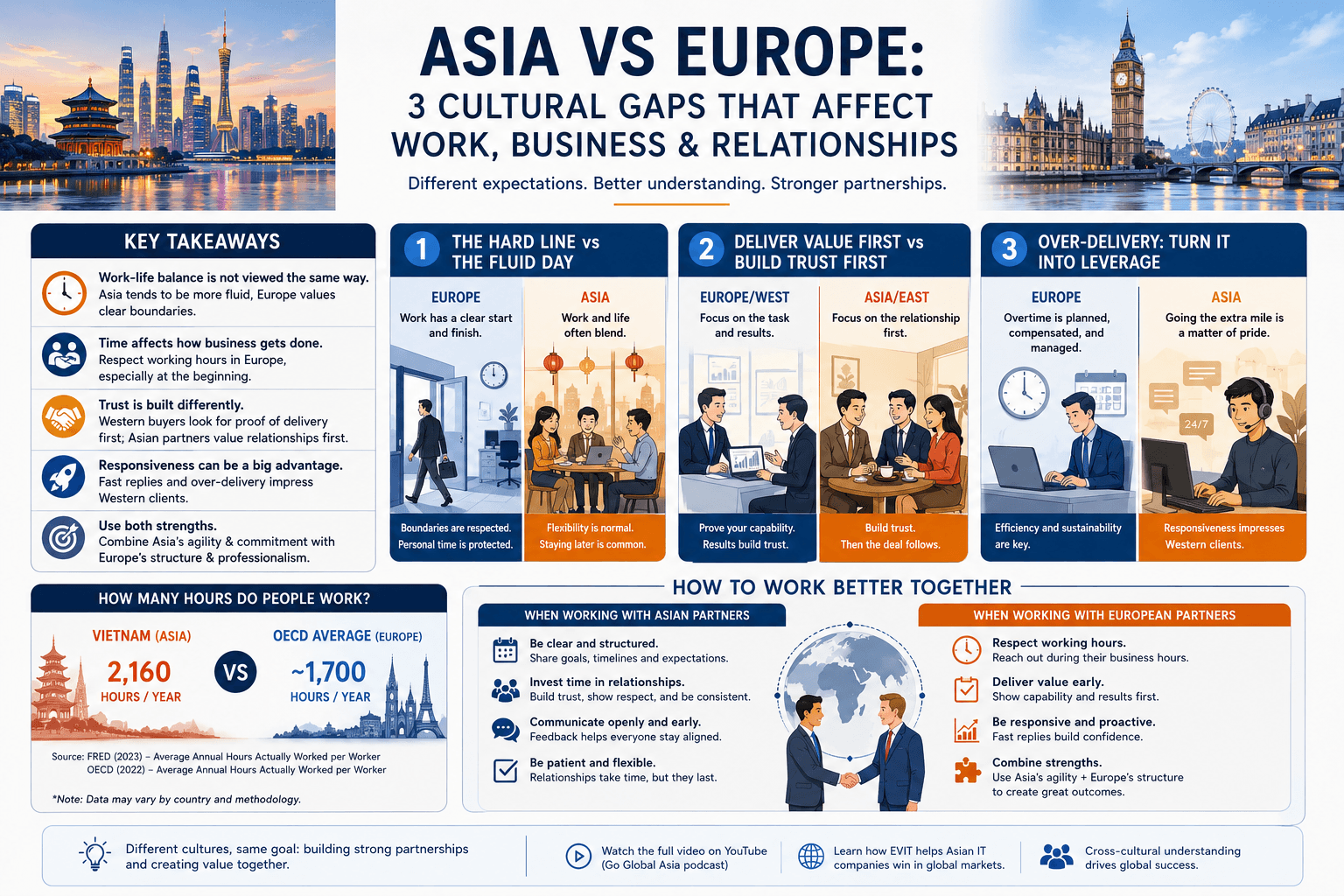

4 Critical Risks in Global Expansion Projects (Plus One More)
Understanding the critical risks in global expansion projects up
front is what separates smooth launches from costly ones. Global
expansion projects most often fail for four predictable reasons:
cultural misunderstanding, rigid operating models, unanticipated
regulatory or tariff shifts, and reputational spillover from local
marketing practices. Vietnamese and other Asian IT vendors entering
Western markets can manage all four with local diligence, adaptable
delivery systems, and a consistent brand standard across regions.
Published: February 3, 2025 · Updated: July 19, 2026
Key Takeaways
- Cultural misunderstanding is rarely about language — it’s about
workplace norms (holidays, bonus expectations, hierarchy) that quietly
damage retention and client trust if left unaddressed. - Replacing a single employee typically costs 50%–200% of that
employee’s annual salary, according to SHRM — a direct financial
multiplier on any cultural or retention misstep during expansion (SHRM,
2025). - Regulatory risk is structural, not occasional: in Thomson Reuters’
2023 Corporate Global Trade Survey, 57% of companies said they outsource
parts of global trade compliance because they can’t find qualified
in-house staff (Thomson
Reuters, 2023). - Trust in business is not uniform across markets — it ranged from 45%
in South Korea to 82% in India in Edelman’s 2024 Trust Barometer,
meaning a reputation strategy that works in one target market can flop
in the next (Edelman,
2024). - The most overlooked risk isn’t cultural or regulatory at all — it’s
reputational contagion from local marketing tactics that read as normal
in one region and as spam in another.
How
Does Cultural Misunderstanding Put Global Expansion Projects at
Risk?
Specifically, cultural misunderstanding puts expansion projects at risk by eroding
trust and retention long before anyone notices a “cultural problem” on
paper — it shows up first as unexplained turnover and quietly stalled
client relationships.
However, language differences are the visible part of cultural risk; the
costlier part is invisible. For instance, a Vietnamese outsourcing company opening a
Western sales office, or a US client expecting a Vietnamese delivery
team to operate on US norms, both run into the same trap: workplace
practices that go unquestioned locally can become deal-breakers abroad.
Vietnam’s traditional 13th-month salary and Tet bonus expectations,
hierarchical communication styles, and differing views on overtime are
common flashpoints. When a bonus tradition is cut without explanation,
or a team defers upward on a decision a client expected fast, the result
isn’t a communication hiccup — it’s attrition and stalled delivery.
Why Cultural Risk Carries a Real Price Tag
That attrition carries a real price tag. SHRM estimates that
replacing an employee costs 50%–200% of their annual salary once
recruiting, ramp time, and lost productivity are counted (SHRM,
2025). For a growing expansion team, even two or three unnecessary
departures caused by cultural friction can quietly consume a
market-entry budget that was supposed to fund growth, not
backfilling.
“Cultural risk almost never shows up as a headline problem — it
shows up as a resignation letter or a client who quietly stops replying.
By the time leadership notices, it’s already expensive to fix,”
notes the EVIT Growth Advisory Team.
What reduces this risk: structured onboarding that
names the cultural gap explicitly (both directions), a local advisor who
can flag friction points before they become resignations, and documented
norms for holidays, bonuses, and decision authority that both sides
agree to in writing.
Why
Does Operational Rigidity Sink Cross-Border Delivery Projects?
Operational rigidity sinks cross-border projects because a delivery
methodology that works perfectly in one market often needs real
adjustment — not just translation — to work in another, and teams that
resist adjusting lose client confidence fast.
Overall, delivery norms vary more than most expansion plans account for. A
structured, waterfall-leaning delivery style that a Japanese client
expects can look inflexible to a Polish client used to fast, iterative
sprints — and vice versa. As a result, reporting cadence, escalation paths,
documentation depth, and meeting norms (who speaks first, how
disagreement is voiced) differ enough between regions that a
one-size-fits-all playbook usually fails somewhere. The mistake isn’t
picking the “wrong” methodology; it’s assuming one methodology travels
everywhere unchanged.
What reduces this risk: building a core delivery
framework with defined, pre-agreed local variants (reporting frequency,
escalation contacts, sprint cadence) rather than a single rigid process,
and testing that framework on a smaller pilot engagement before scaling
it across a new region.
How
Do Shifting Regulations and Tariffs Threaten Global Expansion
Budgets?
Consequently, shifting regulations and tariffs threaten expansion budgets because
compliance costs and duty rates are not fixed inputs you can plan around
once — they are moving targets that can change a project’s margin
mid-engagement.
For example, tariff volatility is a well-documented example, not a hypothetical
one. When the US imposed Section 232 tariffs on imported steel and
aluminum in 2018, aluminum was taxed at 10% and steel at 25% — a
reminder that materials and hardware-adjacent costs in cross-border
projects can shift sharply and with little warning, and that any
expansion budget assuming static input costs is taking on unpriced risk
(U.S.
Customs and Border Protection).
How Regulatory Complexity Compounds Tariff Risk
Furthermore, beyond tariffs, general regulatory complexity is rising for any
company operating across borders. Thomson Reuters’ 2023 Corporate Global
Trade Survey found that 57% of companies now outsource at least part of
their global trade compliance work simply because they cannot find or
retain qualified staff to handle it internally (Thomson
Reuters, 2023). For an IT vendor entering a new market, that data
point translates directly: data protection rules, labor law, and
import/export requirements are specialist work, not a side task for a
project manager.
What reduces this risk: market research before
signing the first client contract, not after; a local legal or
compliance partner on retainer; and budget contingency built in for
regulatory change rather than assuming the rules at signing will hold
for the life of the engagement.
Can
Marketing Practices in One Market Really Damage Your Global
Reputation?
Yes — marketing practices that are considered normal in one market
can damage a company’s global reputation, because reputational damage
doesn’t stay local; it travels through the same LinkedIn feeds, review
sites, and referral networks that connect your target markets.
Meanwhile, this is the risk most expansion plans skip entirely, which is exactly
why it belongs on this list. Specifically, high-volume, low-personalization outreach —
mass cold email blasts or generic connection-request spam — is a common
growth tactic in some markets and a fast way to get flagged, blocked, or
publicly called out in others, particularly in Western B2B markets where
recipients are quick to name-and-shame aggressive outreach on social
media. Notably, for Asian IT and outsourcing vendors specifically, this risk
compounds: a single visible “spam” complaint can reinforce an outdated
regional stereotype that a serious sales motion is trying to overcome,
undermining trust with an entire target segment rather than just one
contact.
Why Trust Levels Make This Risk Worse
Similarly, trust levels also aren’t uniform to begin with, which raises the
stakes of any misstep. Edelman’s 2024 Trust Barometer found global trust
in business sitting at 63%, but with sharp variation by country — from
45% in South Korea and 50% in Japan up to 81–82% in China and India (Edelman,
2024). A market-entry marketing approach that assumes uniform buyer
trust is starting from a false baseline in at least some of its target
regions.
What reduces this risk: a single outreach standard
applied globally (not “aggressive here, careful there”), review of any
locally-run campaign before it launches in a new market, and monitoring
for how the brand is discussed publicly once a new region goes live.
How
Can Vietnamese and Asian IT Vendors Manage All Four Risks at Once?
Ultimately, the four risks compound each other, so the fixes work best applied
together rather than one at a time:
- Invest in two-way cultural understanding before
hiring or signing — not just language training, but a documented view of
workplace norms on both sides of the deal. - Build delivery frameworks with local variants, not
one rigid process forced onto every market. - Treat regulatory and tariff risk as a budget line,
with a local compliance partner and contingency built in from day
one. - Apply one global outreach and marketing standard,
reviewed locally before launch, so growth tactics in one market don’t
create reputational drag in another.
In short, companies that work through all four systematically, typically
alongside a structured Growth
& Market Entry Consulting engagement, tend to catch these risks
in planning rather than paying for them mid-project.
Frequently Asked Questions
What are the 4 critical risks in global expansion
projects?
Cultural misunderstanding, operational rigidity in
delivery methodology, shifting regulations and tariffs, and reputational
damage from local marketing practices that don’t translate well to a new
market.
Why is cultural risk more expensive than it looks?
Because it shows up as turnover, not as a labeled “cultural problem.”
SHRM estimates replacing an employee costs 50%–200% of their annual
salary, so cultural friction that drives departures has a direct,
measurable cost.
How do tariffs affect global expansion budgets?
Tariff and duty rates can shift materially and with little notice — the
2018 US Section 232 tariffs, for example, added 25% on imported steel
and 10% on aluminum — so budgets that assume static input or hardware
costs are taking on unpriced risk.
More Frequently Asked Questions
Why is business reputation considered a “surprising” risk in
global expansion?
Because it’s rarely on the initial risk
checklist. Marketing or outreach practices considered normal in one
market (like high-volume cold outreach) can be seen as spam in another,
and that reputational damage spreads through shared networks rather than
staying contained to one region.
Does trust in business vary by country?
Yes.
Edelman’s 2024 Trust Barometer put global business trust at 63%, but
found it ranged from 45% in South Korea to 82% in India — meaning a
reputation or marketing strategy proven in one market can’t be assumed
to work identically in the next.
How can a Vietnamese IT outsourcing company reduce these
risks before entering a Western market?
By combining local
cultural and regulatory diligence, an adaptable (not rigid) delivery
framework, and a single global marketing standard — ideally validated
with a local advisory partner before the first client contract is
signed, through a service like EVIT’s Growth
& Market Entry Consulting.
Related Resources
- Growth
& Market Entry Consulting - G.O.D.
Sales System - B2B
Marketing & Lead Generation - IT
Vendor Introduction - Case study: How to Enter the South Korea Market (referenced on the
original live page)