
Let me ask you an honest question: are the tech sales strategies that booked your meetings two years ago still working today? If the answer is “not really,” you are not doing anything wrong. The game simply changed.
At EVIT, we run sales for over 100 tech companies right now. As a result, we watch the same shift happen across every single one of them, in real time. Mass campaigns are fading, virtual coffee chats get ignored, and a company logo no longer builds trust on its own.
So in this guide, we break down the 4 tech sales strategies that are actually working to sell tech products and services in 2027: what is working, what is dead, and one tactic we are honestly still testing. Moreover, every point is backed by numbers, both from our own campaigns and from independent research.
Prefer video? Watch the full breakdown from our CEO, Adam Skoneczny: 4 Things That Actually Sell Tech Products in 2027
Key Takeaways: Tech Sales Strategies in 60 Seconds
- Only 3% of the companies in your ideal client profile are buying right now. Signal-based outreach is how you find them.
- 40% of tech decision-makers prefer face-to-face meetings during the consideration phase.
- Personal LinkedIn profiles generate 2.75x more impressions and 5x more engagement than company pages.
- 99% of EVIT’s own inbound demand comes from our CEO’s personal LinkedIn, not the company page.
- 80% of tech buyers now use generative AI at least as much as Google when researching vendors.
Why Old Tech Sales Strategies Stopped Working
Ten years ago, volume won. You built a list of thousands of contacts, blasted a sequence and waited for replies. Today, however, buyers are flooded with identical messages, and they have learned to ignore them.
At the same time, the way buyers research has changed completely. According to Responsive’s October 2025 buyer study, generative AI has overtaken traditional search for 1 in 4 B2B buyers, and nearly two-thirds now use it as much as or more than search when researching vendors. In other words, the buyer journey often starts long before you send your first message.
That is why the tech sales strategies that worked in 2020 now quietly burn your budget.
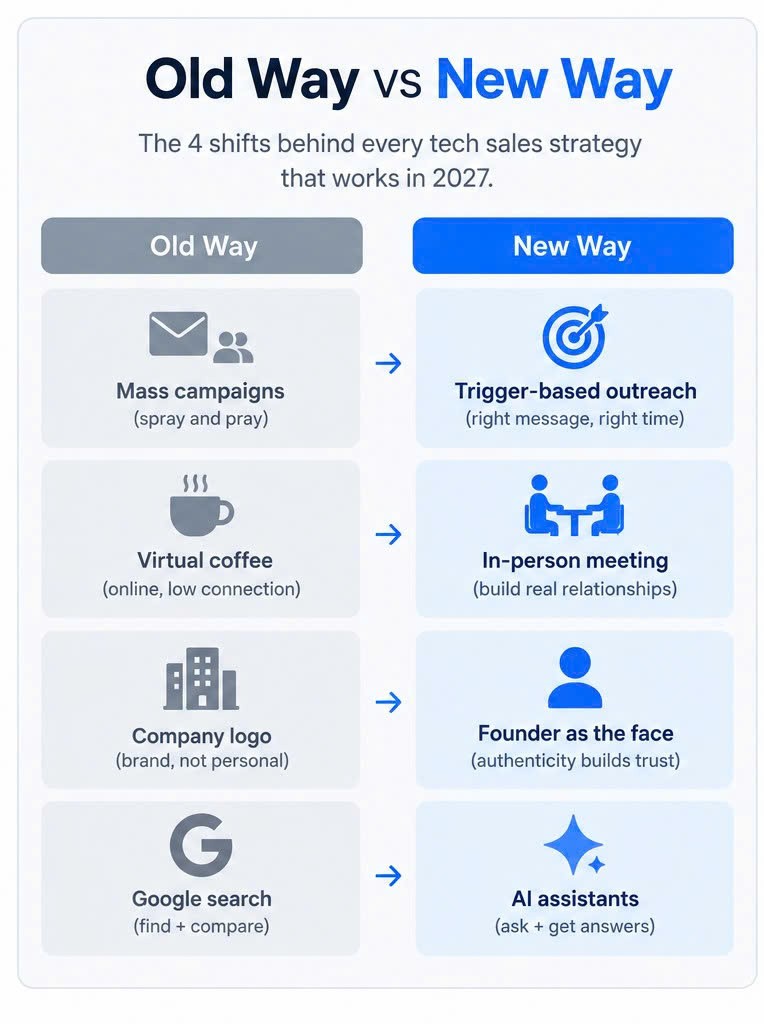
Old vs New Tech Sales Strategies: Side by Side
| Old way | New way (2027) | |
|---|---|---|
| Targeting | Mass campaigns: blast everyone, hope volume wins | Trigger-based: only accounts showing buying signals |
| First meeting | Online “virtual coffee” chat | Get on a plane and meet in person, in their region |
| Brand | Build the company brand, hide behind the logo | The founder becomes the face of the business |
| Discovery | Google search and the company website | Personal content plus AI assistants like ChatGPT |
Consequently, four tactics follow from these shifts. Let’s go through them one at a time.
Tech Sales Strategies #1: Offline Campaigns Tied to a Real Trigger
We are seeing very strong demand for offline campaigns right now. Honestly, people are fed up with the online version. The classic “can we catch up over a virtual coffee?” message is dying.
Instead, what works is traveling to the client, sitting across the table from them, in their region, around a very specific subject. For example, a founder visiting Singapore, Sydney or the Nordics can book a week of meetings around one clear topic, such as a market-entry challenge or a local industry event.
Why In-Person Tech Sales Strategies Beat the Virtual Coffee
The data supports what we see in the field. A Lavidge survey of B2B technology buyers found that 40% of decision-makers prefer face-to-face meetings during the consideration phase. Furthermore, the bigger the company, the stronger the preference: in the final decision phase, 49.5% of enterprise buyers preferred meeting in person, compared with 32.5% of SMBs.
Similarly, the TACK TMI 2024 Buyers’ View of Salespeople report shows that 54% of buyers prioritise face-to-face contact to build trust, and 42% are more likely to buy from people they have met in person.
Here is how to run an offline campaign well:
- Pick one region and one date range. Concentrate your meetings so the trip pays for itself.
- Anchor it to a trigger. A conference, a local event or a regulatory change gives the meeting a reason to happen now.
- Lead with a specific subject. Nobody flies across the world for a generic “intro chat.”
Tech Sales Strategies #2: Signal-Based Outreach to the 3% Buying Now
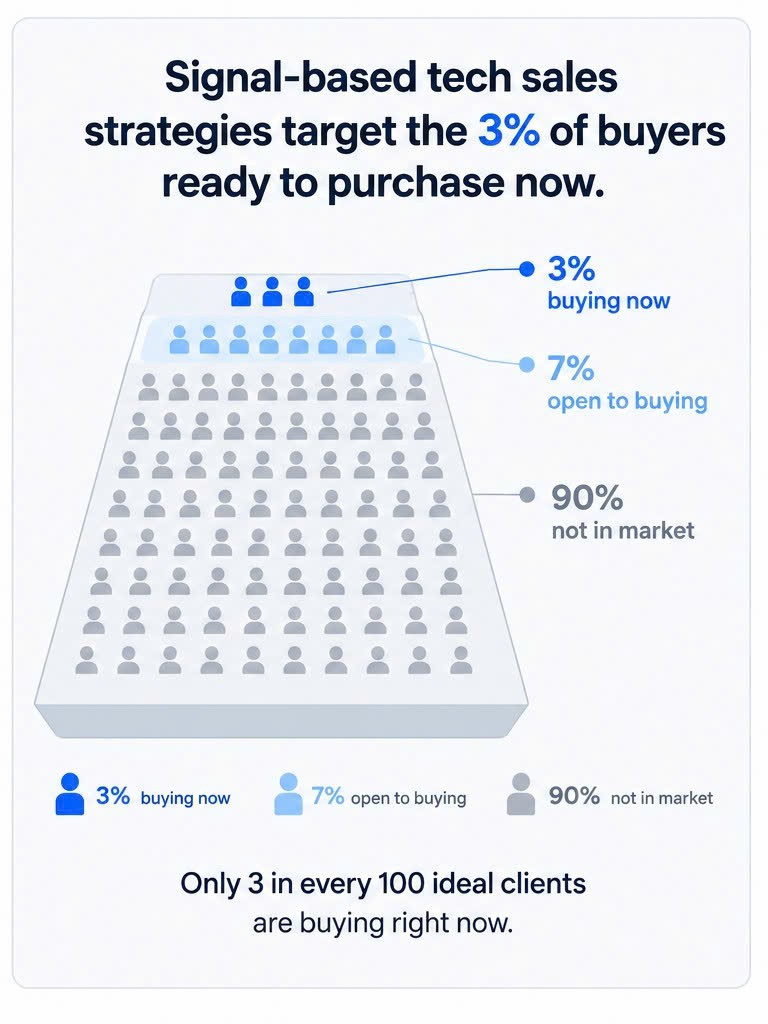
Next, let’s talk about signal-based outreach. Picture every company that fits your ideal client profile sitting in one box. Out of everyone in that box, only about 3% are actually buying right now.
This idea comes from Chet Holmes’ well-known Buyer’s Pyramid: at any moment, roughly 3% of a market is buying now, 7% is open to it, and the remaining 90% is not thinking about it, not interested, or definitely not interested. So if your ideal client list holds 1,000 companies, only about 30 are ready to buy today.
Everyone wants those 3%. That is exactly the problem: they are hard to find, and once you find them, you are competing with everyone else who found them too.
How Signal-Based Tech Sales Strategies Work in 3 Steps
To solve this, we built a system. Here is how it works:
- Detect the signal. We combine AI with data sources like Apollo and LinkedIn to spot signs that an account is buying: a new hire, a funding round, a leadership change, or whatever matters for that account.
- Warm up indirectly first. This is the step most teams skip. We do not message prospects straight away. Instead, we engage for about 3 touches first: commenting, liking and showing up in their feed before we ever connect.
- Open with a question, not a pitch. When we finally reach out, the first message is a question about the exact problem we already know they have. As a result, it starts a conversation instead of triggering a delete.
The One Trigger We Will Not Reveal Publicly
To be honest, we are not going to share the exact trigger we are using in the market we are targeting right now. The moment it goes public, everyone piles into that same market, and that hurts the clients who are already working it.
However, if you tell us your market and your ideal client, we will happily share what we know. Just reach out to our team.
Tech Sales Strategies #3: Personal Branding That Is Actually Yours
Personal branding took us the longest to truly believe in. Yet today, it converts better than almost anything else we run. Building it is one of the highest-leverage things a founder can do; however, it takes real time, and most founders get it wrong in one of two ways.
2 Personal Branding Mistakes That Break Tech Sales Strategies
Mistake 1: Fully outsourcing it. You can collaborate with a person or a team. Still, you cannot hand over your voice completely and expect it to sound like you.
Mistake 2: Letting AI write it. Audiences can spot AI-generated posts within a sentence. What they are missing is a real human opinion. So ask yourself honestly: if your last 10 posts were written by someone else, or by a tool, would anyone notice the difference? Because your audience can.
The Proof: 99% of Our Demand Comes From One Personal Profile
We do not say this without evidence. Right now, 99% of the demand for EVIT comes from our CEO’s personal LinkedIn. Not the company page. One person.
Independent data tells the same story:
- A Refine Labs study found that employee profiles generated 2.75x more impressions and 5x more engagement than the company page, despite having 46% fewer followers.
- Ordinal’s analysis of LinkedIn posts found that 92.38% of the top 1% of posts came from personal profiles.
- According to Ordinal, organic reach on company pages has dropped roughly 60% since 2024, and a typical company post now reaches only 1.6% of its own followers.
If you sell tech, prioritise your channels in this order: 1) LinkedIn, 2) YouTube, 3) Instagram, with your own website and blog underneath it all. For example, Adam shares these lessons weekly on his YouTube channel.
Tech Sales Strategies #4: AI Visibility (Still in Testing)
Finally, AI visibility means being visible when someone asks ChatGPT, Claude or another AI system about your space. We put it last on purpose, because we have not fully tested it yet. Like most companies, we are still in the discovery phase.
Nevertheless, the numbers show why it matters:
- 80% of tech buyers use generative AI at least as much as search for vendor research, and 56% of tech buyers name chatbots as a top source for discovering new vendors, versus 28% in other industries (Responsive, 2025).
- 79% of B2B software buyers say AI search has changed how they research, and 29% now start research in an AI tool more often than on Google (G2 2025 Buyer Behavior Report).
How to Build AI Visibility Into Your Tech Sales Strategies Today
Here is the key connection: if you do not have a personal brand and you are not visible online in the first place, you will not be visible in AI either. It is not a separate game; it is built on top of the same foundation.
That is why our current working approach is simple:
- Publish real opinions under a real name, consistently.
- Use specific numbers, because AI tools love concrete, quotable facts.
- Answer the exact questions buyers ask, for example in FAQ sections like the one below.
- Keep your positioning identical across LinkedIn, YouTube and your website.
Why No Tech Sales Strategies Can Fix a Broken Offer
To sum up, here is what is actually working to sell tech products and services in 2027: offline campaigns tied to a real trigger, signal-based outreach to the 3% who are buying, personal branding that is truly yours, and AI visibility, which we are all still figuring out together.
But here is the honest part. None of these 4 tactics will save you if your offer is not right, if you do not know your ideal client, or if there is a real problem underneath your business. In that case, fix the foundation first. Our G.O.D. Sales System walks you through offer, ICP and sales process step by step, while our B2B marketing and lead generation service helps you turn that foundation into pipeline.
Tech Sales Strategies 2027: Key Numbers at a Glance
| Number | What it means | Source |
|---|---|---|
| 3% | Share of a market buying right now | Chet Holmes, Buyer’s Pyramid |
| 3 touches | Indirect engagement before we connect | EVIT campaigns |
| 40% | Tech decision-makers who prefer face-to-face meetings | Lavidge |
| 54% | Buyers who rely on face-to-face contact to build trust | TACK TMI 2024 |
| 2.75x / 5x | More impressions/engagement on personal profiles | Refine Labs |
| 99% | EVIT demand coming from the CEO’s personal LinkedIn | EVIT |
| 80% | Tech buyers using GenAI at least as much as search | Responsive 2025 |
| 29% | Buyers starting research in AI tools more than Google | G2 2025 |
FAQ: Tech Sales Strategies in 2027
What are the best tech sales strategies in 2027?
The 4 tech sales strategies working best in 2027 are offline campaigns tied to a real trigger, signal-based outreach to the 3% of buyers in market, founder-led personal branding, and AI visibility. In practice, the first 3 are proven, while AI visibility is still being tested.
How do you find the 3% of buyers ready to purchase?
You track buying signals such as new hires, funding rounds and leadership changes, using AI plus data from tools like Apollo and LinkedIn. Then, you warm the account up with about 3 indirect touches before opening with a question about their specific problem.
Does personal branding really work for B2B tech sales strategies?
Yes. Personal profiles generate 2.75x more impressions and 5x more engagement than company pages, and 99% of EVIT’s own demand comes from one personal LinkedIn profile. However, it only works if the voice is genuinely yours.
Ready to Build Your 2027 Sales System?
If you want these tactics running inside a predictable pipeline, book a free consultation with EVIT. Meanwhile, see how other tech companies did it in our case studies, or browse more guides on the EVIT blog.