
A Comprehensive Guide to Global Expansion for IT Businesses
Global expansion for IT businesses works best when you match your
company’s strengths to the right region instead of chasing every market
at once. Specifically, the US offers the biggest demand but the toughest competition;
Europe offers cultural fit but more regulation; APAC (including
intra-Asia expansion) often offers the fastest, lowest-friction entry
point for growing IT vendors.
Key Takeaways
- The global IT services outsourcing market is projected to reach USD
1,219.31 billion by 2030, growing at an 8.6% CAGR from 2025-2030 —
demand for outsourced IT talent is not slowing down (Grand View
Research, November 2024). - Indeed, the United States delivers the largest deal sizes but the most
saturated competitive landscape; win rates depend on niche positioning,
not price. - Meanwhile, Europe rewards cultural alignment and long-term relationship
building but requires navigating GDPR, works-council rules, and
country-specific procurement norms. - Notably, Vietnam’s own IT industry illustrates the capacity constraint
driving outward expansion: roughly 530,000 developers nationwide, with
an annual shortage of 150,000-200,000 programmers and engineers forecast
through 2025 (TopDev, Vietnam IT Market Report 2023) — a strong argument
for partnering rather than competing head-on for the same talent
pool. - Ultimately, no single region is universally “best” — the right first market
depends on your team’s language skills, domain expertise, and risk
tolerance.
What Does Global Expansion for IT Businesses Actually Require?
In practice, the three regions that matter most for IT vendors expanding
internationally are North America (primarily the US), Europe, and the
wider Asia-Pacific (APAC) region. In particular, each rewards a different kind of
readiness: the US rewards specialization and speed, Europe rewards trust
and compliance discipline, and APAC rewards relationship-driven,
lower-friction entry. Typically, most successful vendors pick one region to prove
the model before expanding further.
In fact, Vietnam’s ICT market itself grew 14% in 2023 to roughly VND 240
trillion (about USD 10.2 billion), and is projected to exceed USD 17
billion by 2027 (U.S. International Trade Administration, Vietnam ICT
Country Commercial Guide, updated January 2024) — a reminder that the
outbound pressure to win Western clients is being matched by rising
domestic costs and competition at home.
How Does
the US Market Compare for IT Global Expansion?
Indeed, the US is the largest single market for outsourced IT and software
services, but it is also the most contested. (Note: the readiness scores
below reflect EVIT’s internal qualitative assessment framework, not a
third-party index.)
| Factor | US Market | Notes |
|---|---|---|
| Market demand | High | Deepest budgets, fastest sales cycles for the right ICP |
| Competition | Very high | Crowded with domestic firms, nearshore (LatAm), and other Asian vendors |
| Cultural alignment | Moderate | Direct communication style; less relationship-first than APAC |
| Business openness | High | Straightforward incorporation and contracting, but heavy vendor-vetting |
US buyers frequently choose based on niche credibility (a specific
tech stack, industry vertical, or compliance certification) rather than
lowest hourly rate. As a result, vendors who enter without a sharp positioning
statement tend to get lost among hundreds of similar-looking outsourcing
pitches.
How Does Europe
Compare for IT Global Expansion?
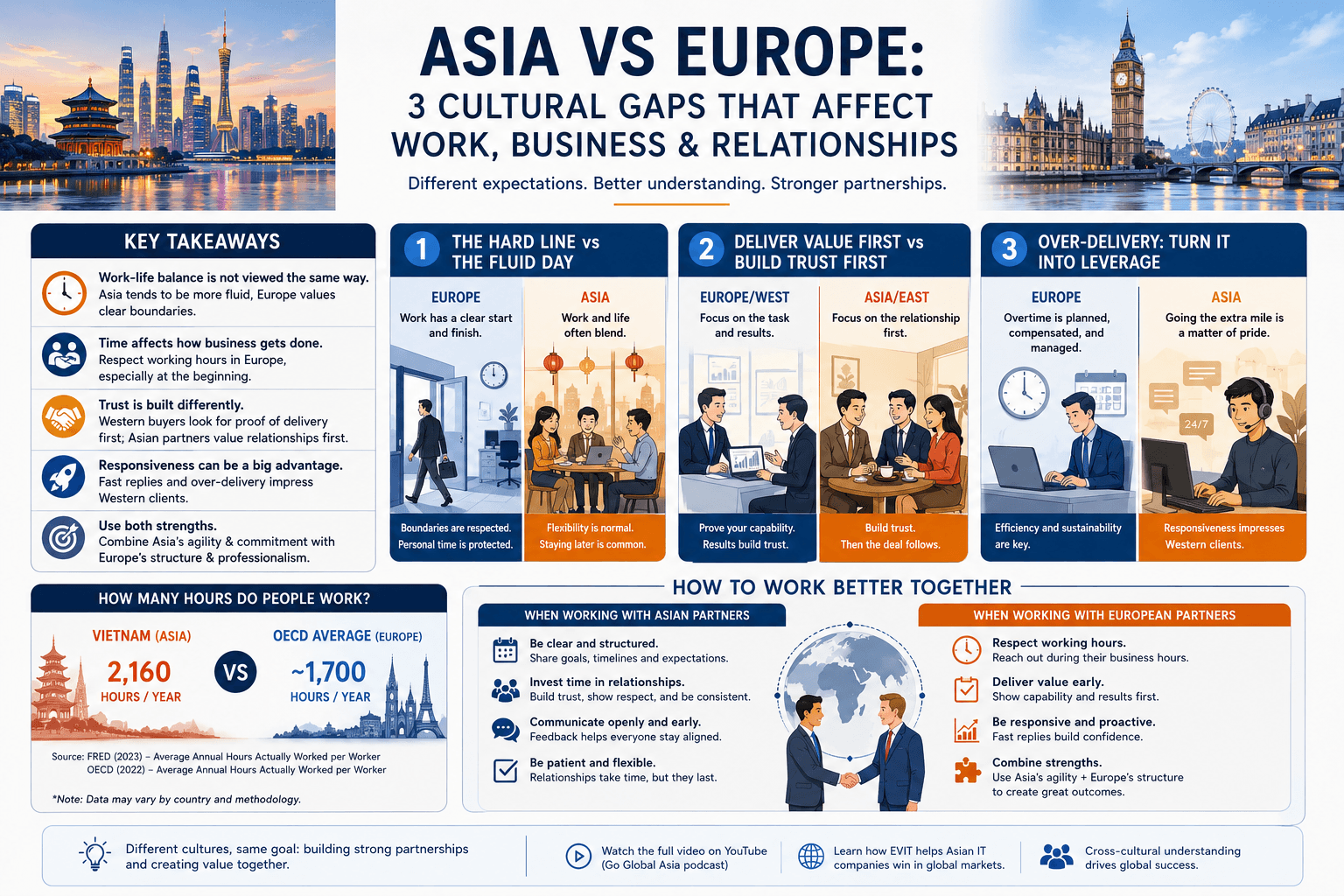
In contrast, Europe offers stronger cultural alignment for many Vietnamese and
broader Asian IT vendors than the US does, particularly with Northern
European and German-speaking buyers who value structured processes,
documentation, and long-term partnership over transactional pricing. The
trade-off is regulatory complexity: GDPR compliance, local labor and
works-council considerations for any on-the-ground hires, and
country-by-country differences in procurement expectations (Germany, the
Nordics, and the UK each behave differently even within “Europe”).
Vendors that succeed in Europe typically invest earlier in compliance
documentation and data-handling transparency than they would for a
US-only strategy, and they use that discipline as a selling point rather
than treating it as a cost center.
Why Is
APAC Often the Fastest Entry Point for IT Vendors?
Meanwhile, APAC — including intra-Asia expansion and inbound demand from
Australia, Singapore, and Japan — combines relatively strong market
demand with lower direct competition than the US or Europe, plus closer
cultural and time-zone alignment for many Vietnamese vendors. However, regulatory
environments still vary significantly by country, so “APAC” is not a
single market to enter with one playbook; Singapore, Japan, and
Australia each require distinct approaches to contracting, communication
cadence, and even sales terminology.
For vendors testing global expansion for the first time, APAC often
produces faster initial wins because relationship-building norms and
time-zone overlap reduce the friction of the first few deals — useful
validation before committing more resources to a harder market like the
US or EU.
What
Should IT Companies Do Before Choosing a Market?
- Audit your current client base for the region your
best-fit clients already resemble. - Score your team’s readiness on language, time-zone
overlap, and compliance capacity for each candidate region. - Pick one primary market rather than spreading thin
across three at once. - Build a repeatable outbound and referral engine for
that market before adding a second. - Revisit the decision every 6-12 months as your
team, case studies, and capacity change.
Frequently Asked Questions
What is the best country for IT companies to expand to
first?
There’s no universal answer — it depends on your team’s
language capability, existing case studies, and risk tolerance. The US
offers the biggest opportunity but the toughest competition; Europe
rewards compliance discipline; APAC often provides the lowest-friction
first win.
How big is the global IT outsourcing market?
The
global IT services outsourcing market was projected to reach USD
1,219.31 billion by 2030, growing at an 8.6% CAGR between 2025 and 2030
(Grand View Research, November 2024).
Do I need a local entity to sell into a new region?
Not always at first. Instead, many IT vendors start with direct sales and remote
delivery, then consider a local entity, partner, or representative once
deal volume justifies the overhead — particularly in Europe, where local
presence can simplify contracting.
More Frequently Asked Questions
Why is cultural alignment important in global
expansion?
Notably, cultural misalignment slows deal cycles and damages
trust even when technical delivery is strong. Buyers in Europe and APAC
in particular tend to favor vendors who match their communication style
and decision-making pace, not just their price point.
How long does it typically take to win a first client in a
new market?
This varies widely by region and positioning, but
most vendors should plan for a multi-month sales cycle (often 3-9
months) for a first enterprise-level client in a new market, especially
in the US and Europe.
Should a growing IT vendor expand into multiple regions at
once?
Generally no. Overall, concentrating resources on one region until
you have a repeatable playbook and reference clients produces stronger
results than spreading a small team across three unfamiliar markets
simultaneously.