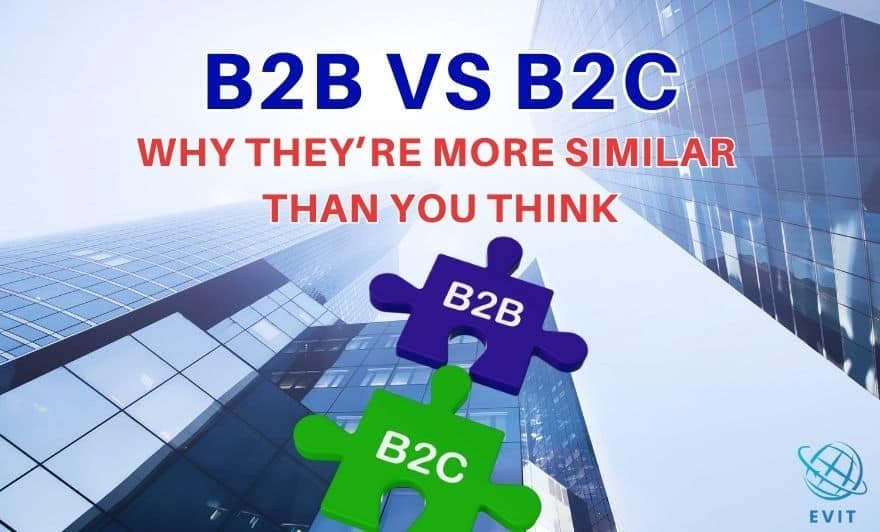
When it comes to sales, most people think of B2B (business-to-business) and B2C (business-to-consumer) as two separate worlds. One is “all about ROI and contracts,” while the other is “all about emotions and quick wins.”
But here’s the truth: they’re not so different after all. In fact, if you want to go global and compete in today’s competitive landscape, it’s time to start learning from both sides.
At EVIT, where we provide sales consulting for IT companies in Vietnam and beyond, we’ve seen firsthand how founders and sales teams often fall into the trap of treating B2B and B2C as completely disconnected. That mindset can limit growth — especially for those in the Vietnam IT market aiming for international clients.
The Mindset Shift: People Buy, Not Companies
In B2B, the traditional mindset is to focus only on ROI, cost optimization, and efficiency. In B2C, the focus is on emotions, desires, and instant gratification.
But in reality, both categories share the same truth: people make decisions. Behind every contract is a CEO worried about risk, a CFO concerned about costs, or a project manager who doesn’t want to make a bad call.
Understanding the personal fears, motivations, and desires of decision-makers is just as crucial in B2B as in B2C.
The Sales Process: Longer, But Human-Centered
Yes, B2B sales cycles are longer. Higher deal values, multiple stakeholders, and more approvals slow things down. By contrast, B2C often happens in a moment of emotional impulse.
But the lesson here isn’t just about process length. It’s about timing and human connection. Whether you’re selling software to a European enterprise or bubble tea to a teenager, success depends on reaching people at the right moment with the right message.
Practical Takeaways for IT Companies
For IT vendors in Vietnam looking at IT business expansion consulting and market entry strategy, here are three key lessons:
- Balance ROI with empathy. Yes, show the numbers. But also address the personal fears and motivations of stakeholders.
- Map stakeholders carefully. The CEO, CFO, technical lead, and end-user may all play a role. Winning requires aligning with all of them.
- Adapt your sales techniques. Think beyond transactions — focus on building trust and creating long-term partnerships.
Final Thoughts
The line between B2B and B2C is thinner than most think. Both demand strategy, empathy, and timing.
At EVIT Organization, we’ve seen that the companies who succeed in the Vietnam IT market and beyond are the ones who combine the best of both worlds: the structured approach of B2B with the human-centered mindset of B2C.