In today’s fast-moving digital world, global expansion isn’t just a growth option — it’s a necessity for ambitious IT firms. But entering Western markets from Asia isn’t just about crossing borders. It’s about crossing cultures.
Specifically, we’ve spent years guiding Vietnamese and Asian tech companies into global markets. In this article, we would like to share firsthand insights into the hidden cultural differences that often make or break international deals.
1. Business Networking: Professional vs Personal
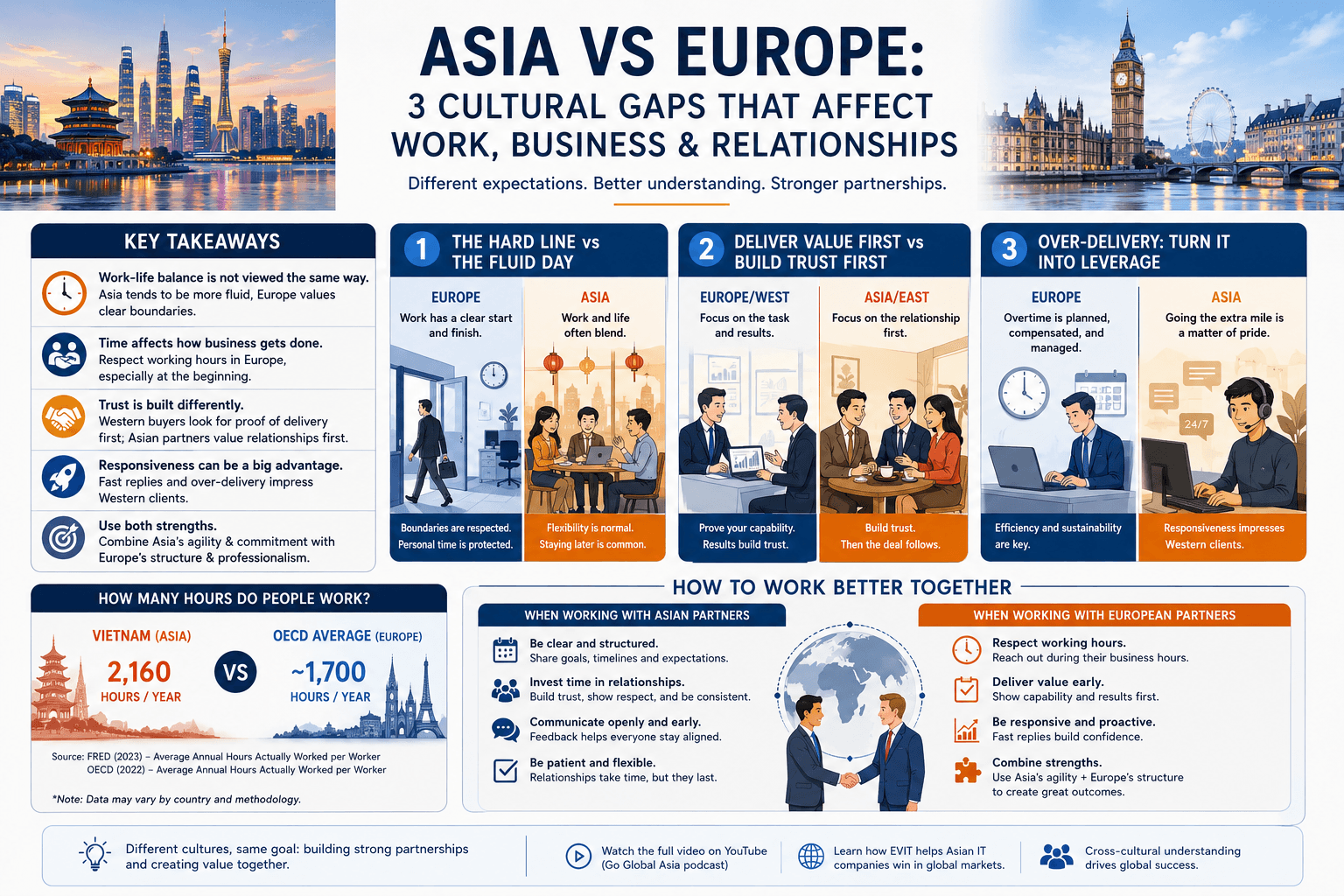
In Asia, business is deeply personal. Relationships are nurtured over coffee, karaoke, or shared meals. There’s a natural blend between personal and professional life.
In contrast, Western business culture is clearly segmented. Networking happens during working hours — often in formal environments. A cold outreach at 8:00 p.m. or an overly personal question early in the relationship might backfire. Therefore, if you’re an Asian company entering a Western market, your market entry strategy should include localized outreach practices and an understanding of business etiquette.
Takeaway: Build the relationship professionally first — social moments come later.
2. Understanding Risk: Logic vs. Emotion
Western clients typically assess risk through data: timelines, ROI projections, and factual case studies. In contrast, many Asian businesses assess risk more emotionally — often based on trust in the individual rather than the metrics.
As a result, if you’re pitching to a European or U.S. partner, your sales consulting for IT companies approach must include hard data, proven results, and clear deliverables. Emotional connection can follow, but it won’t substitute for logic in decision-making.
Takeaway: Remove risk from your pitch with facts, not just relationships.
3. Work-Life Balance and Expectations
Indeed, from our Vietnam IT market experience, it’s common to see employees working long hours, sharing dinner at their desks, and blending work with personal life. In contrast, in Europe, work ends at 5:00 p.m. — and personal life begins. Asking for after-hours meetings or social hangouts too early in a relationship might be seen as intrusive.
Takeaway: Respect time boundaries. Align your sales and meeting schedules with local norms.
4. Time Perception: A Hidden Deal-Breaker
In some Asian markets, punctuality is flexible. In Europe, however, being late by even 10 minutes can damage your credibility. Your partner may interpret it as a lack of respect.
In short, if you’re looking to establish an IT presence in new markets, particularly in Europe or North America, time management isn’t optional — it’s a brand signal.
Takeaway: Time is respect. Show up early.
5. Decision-Making and Leadership Hierarchies
Western teams often make decisions collaboratively, expecting open dialogue from all stakeholders. In Asia, decisions are frequently top-down, and hierarchy matters.
As a result, this cultural gap can cause frustration during brainstorming sessions or strategic planning meetings. If you’re entering a Western market and leading a multinational team, adapt your management style to encourage collective ownership.
Takeaway: Build global teams that can collaborate across decision-making cultures.
Final Thought: Global Growth Requires Local Intelligence
Overall, as global markets become more accessible, the opportunity to expand the market grows. Ultimately, CEOs must be aware that what works in Hanoi might fall flat in Hamburg. Culture shapes business — and ignoring that can cost you deals. Our global expansion services can help you navigate these cultural gaps with confidence.
🔍 Want more insights on global expansion strategy and market entry strategy for tech companies?
👉Watch full episode here: https://www.youtube.com/watch?v=6bLFJ1dYjJk
👉Follow our Facebook Fanpage: https://www.facebook.com/goglobalasia1