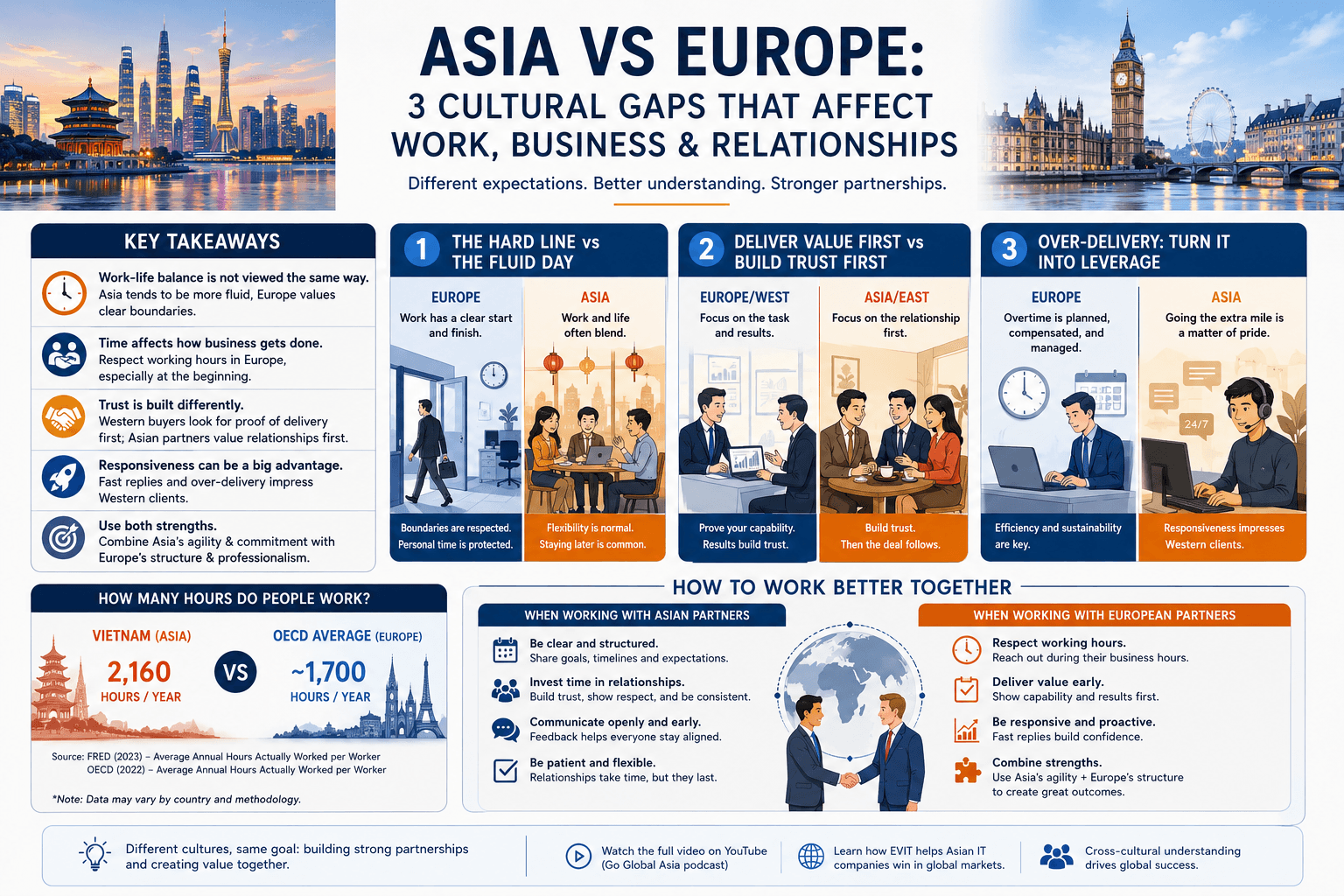

The 2 Key Global Expansion Challenges Every IT Vendor Faces
The biggest global expansion challenges rarely come from weak
products. Global expansion rarely stalls because of weak products — it
stalls because of cultural blind spots. Asian IT vendors typically hit
two walls: mismatched business ethics/communication norms, and a sales
process built for local buyers rather than Western ones. Overcoming both
takes deeper market research, relationship-first outreach, tailored
pitching, local partners, and patience.
Key Takeaways
- The two biggest global expansion challenges are (1) business
ethics/communication differences and (2) a sales process not adapted to
the target market. - 68% of global professionals say cultural differences are the single
biggest obstacle to cross-border team performance (RW3 CultureWizard,
2018). - Vietnam ranks 63rd of 116 countries in English proficiency, in the
“moderate” band (EF English Proficiency Index, 2024) — a real factor in
sales and negotiation friction, not just a soft-skills issue. - Five practical fixes close most of the gap: deeper market research,
relationship-first selling, tailored pitches, local partners, and
patience with longer sales cycles.
What Are the Biggest Global Expansion Challenges IT Vendors Face?
The two challenges that most often derail an otherwise capable IT
vendor’s global expansion are: (1) differences in business ethics and
communication norms, and (2) a sales process still built for the home
market rather than the target one. Neither is about product quality or
price — both are about fit.
This matters because the most common reason companies fail when they
expand — anywhere, not just internationally — is not a bad product.
Research from CB Insights on why startups fail found that “no market
need” was cited in 42% of post-mortems, more than any other single
cause, ahead of running out of cash or being outcompeted (CB Insights,
“Top 12 Reasons Startups Fail,” 2021 update). For a Vietnamese or
Southeast Asian IT vendor entering a US or EU market, “no market need”
is rarely the real story — the real story is usually a market that
wasn’t understood well enough before the pitch was made.
Challenge
1: Why Do Business Ethics Differences Derail Global Deals?
Because what counts as professional, trustworthy, and persuasive
behavior is not universal — it is learned, and it differs sharply
between Southeast Asian and Western business cultures. A pitch, contract
clause, or negotiation tactic that reads as respectful and thorough in
Hanoi or Da Nang can read as evasive or slow in Berlin or Boston, and
vice versa.
Four areas cause the most friction:
- Communication style. Southeast Asian business
communication tends to be indirect and context-heavy, prioritizing
harmony and face-saving. Western buyers, especially in the US and
Northern Europe, typically expect direct, explicit statements of scope,
risk, and price. A vendor that hedges to be polite can be read as
uncertain or evasive. - Negotiation pace and approach. Relationship-first
negotiating cultures build trust over multiple meetings before
discussing terms in depth. Deal-first cultures want terms on the table
early, then build trust through execution. Mismatched expectations here
stall deals that both sides actually want to close. - Sales priorities. Relationship-focused sellers lead
with rapport and long-term partnership; outcome-focused buyers lead with
ROI, SLAs, and risk mitigation. Both are valid — but a pitch built for
the wrong priority set gets ignored. - Value perception. Price-led selling (“we’re
cheaper”) signals commodity thinking to a Western enterprise buyer who
is evaluating quality, security posture, and delivery predictability
first, and cost second.
This is not a small-print issue. 68% of respondents in RW3
CultureWizard’s Trends in Global Virtual Teams survey named cultural
differences as the biggest obstacle to global team performance, ahead of
time zones or language itself (RW3 CultureWizard, 2018). If
cross-cultural friction is the top blocker for teams that are already
under contract and working together daily, it is a far bigger blocker at
the pre-contract, trust-building stage of a sales relationship.
Challenge
2: Why Does a Sales Process Built for Home Markets Fail Abroad?
Because the buying journey, decision-makers, and objections are
different for a Vietnamese IT company selling to Vietnamese or regional
clients than for the same company selling to a US enterprise or EU
mid-market buyer. A sales process that works domestically —
inbound-heavy, referral-driven, price-competitive — often has no
equivalent trust signal in a market where the buyer has never heard of
your company and has dozens of other outsourcing options.
Two compounding factors make this harder for IT outsourcing vendors
specifically:
- Language and communication precision. Vietnam’s EF
English Proficiency Index 2024 score places the country 63rd of 116
countries surveyed, in the “moderate” proficiency band (EF Education
First, EF EPI 2024). That is a real, measurable gap in a sales function
where scoping calls, SOWs, and technical negotiations depend on precise,
confident English — not just conversational fluency. - Category perception. Western buyers evaluating
Asian IT vendors are often unconsciously buying against a “cheap
outsourcing” stereotype from a decade ago. A sales process that doesn’t
actively counter that — with case studies, security certifications, and
named client outcomes — inherits the stereotype by default.
How
Can IT Vendors Overcome These 2 Global Expansion Challenges?
Five moves close most of the gap between “technically capable vendor”
and “vendor Western clients actually sign with”:
| Fix | What It Does | Who Should Own It |
|---|---|---|
| Deeper market research | Identifies real buyer priorities, competitors, and pricing norms before outreach starts |
Leadership + market entry advisor |
| Relationship-first outreach | Builds trust before the pitch, matching how enterprise buyers actually decide |
Sales/BD team |
| Tailored pitches per market | Replaces generic decks with ROI- and risk-framed messaging for the specific buyer culture |
Sales + marketing |
| Local partners or advisors | Adds a trusted local voice that can vouch for the vendor and translate norms both ways |
Leadership |
| Patience with longer cycles | Prevents premature discounting or ghosting when a deal takes 3-6 months instead of 3-6 weeks |
Sales leadership |
“Vendors who treat cultural fit as a sales input — not an
afterthought — close Western deals faster than vendors who simply drop
their price to compensate,” notes the EVIT Growth Advisory Team. In
practice, that means budgeting real time for market research and
relationship-building before the first outbound message goes out, not
after the first deal falls through.
Frequently Asked Questions
What are the 2 biggest challenges in global
expansion?
The two most common are (1) mismatched business
ethics and communication norms between the vendor’s home culture and the
target market, and (2) a sales process still designed for domestic
buyers rather than the new market’s decision-makers.
Why do cultural differences cause deals to fall
through?
Because trust signals differ by culture — indirect
communication, relationship-first negotiating, and price-led pitching
can each be misread by a Western buyer expecting direct, ROI-framed,
trust-through-execution communication, causing otherwise strong vendors
to be passed over.
How long does global expansion typically take for an IT
vendor?
There is no fixed timeline, but enterprise sales cycles
in the US and EU commonly run 3-6 months or longer for a first deal with
a new vendor, compared to shorter, referral-driven cycles common in
domestic Southeast Asian sales.
Does lowering price fix a global expansion sales
problem?
Usually not. Price-led positioning tends to signal
commodity thinking to enterprise buyers who are evaluating security,
delivery predictability, and cultural/communication fit first —
discounting without addressing those gaps rarely converts stalled
deals.
Do we need a local partner to expand into a new
market?
It is not mandatory, but a local partner or advisor who
can vouch for the vendor and translate norms in both directions
consistently shortens the trust-building phase of the sales cycle.
What role does English proficiency play in global
expansion?
A meaningful one for IT outsourcing specifically —
Vietnam scored in the “moderate” band (63rd of 116 countries) on the EF
English Proficiency Index 2024, and imprecise English in scoping calls
and SOWs can directly undermine buyer confidence.
Related Resources
- Growth
& Market Entry Consulting — for vendors building a market-entry
plan around these two challenges - G.O.D.
Sales System — for adapting a domestic sales process into one built
for Western buyers - B2B
Marketing & Lead Generation — for tailoring outbound messaging
and positioning per market - Go Global
Asia community — for peer discussion with other Asian IT leaders
navigating the same challenges