In this article, you’ll learn:
- How to research the South Korean IT market before investing.
- Why defining one Ideal Client Profile (ICP) is critical.
- How to validate your assumptions with real prospects.
- The business etiquette that helps build trust with South Korean buyers.
- The mistake that cost us a deal—and how to avoid it.
- When to scale your market entry strategy with confidence.
What Does It Take to Enter the South Korean IT Market?
Entering the South Korean market for IT services takes disciplined research, a single well-defined Ideal Client Profile, respect for Korean business etiquette, and a willingness to test before you scale. Over the past 7 years, I have helped IT organizations across five countries: Vietnam, Bangladesh, Sri Lanka, India, and Japan, expand into new markets. South Korea is one of the most rewarding and most demanding of them. Below is the step-by-step journey I went through with my clients, including the mistakes that cost us a deal, so you can move faster than we did.
The prize is large. The South Korean IT services market was worth roughly US$35.8 billion in 2025, and depending on the forecast, it is growing at anywhere from 5% to 12% per year, heading toward US$44–54 billion by 2029–2030, driven by government digital-platform strategy and sustained 5G and AI investment. But that opportunity is only accessible to vendors who approach it strategically and with cultural sensitivity.
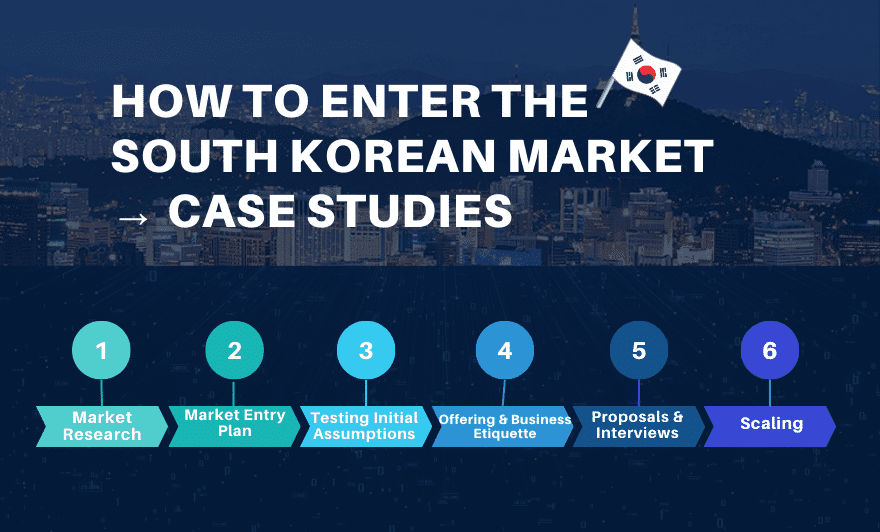
Step 1: Market Research (Indirect + Direct)
We began by deeply understanding the market’s potential on two levels: indirect and direct research.
Indirect research — analyzing the market from the desk
Indirect research focused on specific, verifiable information about the market. The key criteria we analyzed were:
- Market size and growth: the overall size and projected growth of the South Korean IT services market.
- Target audience: the key customer segments that actually require external IT services.
- Competitor analysis: existing IT service providers in South Korea — their strengths, weaknesses, service offerings, and client base. Yes, we mapped who they work with, who they are prospecting, and the methods they use.
- Market trends: emerging technologies and trends shaping the South Korean IT sector.
- Pricing: prevailing pricing models and regulatory considerations for IT services in South Korea.
- Opportunities and challenges: the concrete opportunities and risks of entering the market.
Direct research – boots on the ground in South Korea
Direct research meant sending team members to South Korea in person. Their objectives were to conduct interviews and focus groups with salespeople, industry experts, and network connections, and to gain a first-hand understanding of specific client needs and cultural preferences. No report replaces sitting across the table from a real South Korean buyer.
Step 2: Build the Market Entry Plan Around One Ideal Client Profile
With the research completed, we defined our Ideal Client Profile (ICP) and the plan around it. Three decisions mattered most:
- Target segments: which industries and verticals to focus on first.
- Approach channels: how to reach those clients – direct campaigns, LinkedIn, or email.
- Service offerings: what to offer based on real, observed market demand rather than what we assumed they wanted.
Step 3: Test Your Initial Assumptions on Real Leads
This is where it got exciting: we put the research into action. We confirmed our focus segment and the best approach for converting cold leads into warm leads. For our targeted segment, the two most effective channels were direct campaigns (meeting offline after an initial email) and a LinkedIn-based approach. Testing early meant we validated our assumptions with evidence before committing serious budget.
Step 4: Offering & South Korean Business Etiquette
Korean clients have distinct business practices, and respecting them is often the difference between a second meeting and silence. Here is what we learned:
- Send a company profile before the meeting. This saves time in the room, introductions are already handled, so you get straight to substance.
- Skip the small talk. In initial meetings, Korean clients generally prefer to get straight to the point.
- Earn trust deliberately. Koreans don’t trust easily. Make your website and sales materials flawless, bring a translator, and choose a professional venue to leave a strong impression.
- Provide guarantees. To remove perceived risk, offer guarantees that demonstrate your commitment and reliability.
Step 5: Proposals & Interviews: The Mistake That Cost Us a Deal
Once we started generating leads, we hit our first significant challenge during team interviews. Despite a strong proposal, we lost the deal because of translation issues. Our translator lacked technical knowledge, which led to poor communication between our developers and the client.
| Lesson learned: Always secure a translator who understands technical terminology. In a technical sales meeting, a general-purpose interpreter is not enough — a single mistranslated requirement can sink an otherwise winning proposal. |
Step 6: Scale Only What Works
Once all the pieces were in place – client profiles, approach methods, offerings, and trust-building strategies, we scaled deliberately. Concretely, we:
- Focused resources on the activities that had proven to work.
- Reallocated budget from other markets into Korea.
- Sent our top team members to Korea for an on-the-ground business trip.
Scaling before Steps 1–5 are solid simply multiplies your mistakes. Scaling after them multiplies what already works.
Key Lessons: The South Korea Market-Entry Checklist
|
Lesson |
Why it matters |
| Have someone fluent in South Korean on the team from day one
|
South Korea’s “moderate” English proficiency makes language a real barrier
|
| Conduct thorough indirect + direct research
|
Decisions should rest on evidence, not assumptions
|
| Design client profiles and approach channels carefully
|
The right ICP and channels are a genuine game-changer
|
| Learn and respect South Korean business etiquette
|
Etiquette signals respect and builds trust
|
| Build trust with professionalism and guarantees
|
South Koreans don’t trust easily
|
| Scale up and maximize market potential once confident
|
Momentum compounds once the model works
|
| Offer project-based models – often preferred over long-term contracts
|
Commercial preference in the market
|
| Use a translator with technical knowledge in crucial meetings
|
Technical nuance is easily lost
|
The South Korean market has significant potential for IT services, if you approach it strategically and with cultural sensitivity.
FAQs: Entering the South Korean IT Market
How big is the South Korean IT services market?
It was worth approximately US$35.8 billion in 2025 and is projected to reach roughly US$44–54 billion by 2029–2030, growing at an estimated 5–12% per year depending on the forecast, driven by government digital strategy and 5G/AI investment.
What is the first step to enter the South Korean IT market?
Research on two levels: indirect desk research (market size, competitors, pricing, trends) and direct in-country research (interviews and focus groups with buyers, experts, and your network). Evidence first, budget second.
What are the most important rules of South Korean business etiquette for IT sales?
Send a company profile before the meeting, skip small talk and get to the point, invest heavily in looking credible to earn trust, bring a translator, meet in a professional venue, and offer guarantees to remove risk.
Do South Korean clients prefer project-based or long-term contracts?
In our experience, South Korean clients often prefer project-based models over long-term contracts, so package and price your offering accordingly.
Why do I need a technical translator specifically?
Because South Korea sits only in the “moderate” band of the EF English Proficiency Index (~#48–50 of 116 countries), and a general interpreter can mistranslate technical requirements. We lost a winnable deal for exactly this reason.
Sources & Further Reading
- South Korea IT services market size and growth — Grand View Research, Statista, Mordor Intelligence.
- English proficiency ranking — EF English Proficiency Index: South Korea.
- Primary source: Selling to South Korea? 4 Rules You Must Follow to Get More Clients (Adam Skoneczny).