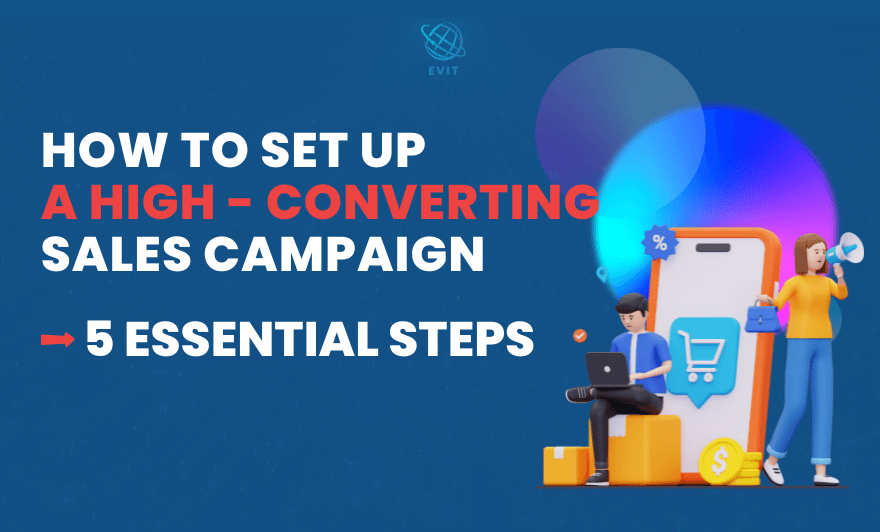
How to Set Up a High-Converting Sales Campaign in 5 Steps
A high-converting sales campaign follows five steps: set one clear
goal, define a precise Ideal Customer Profile, write personalized
messaging, run it across multiple channels (email, LinkedIn, calls,
content), then track and optimize weekly. For Vietnamese IT vendors
targeting Western clients, ICP precision and message personalization
drive the largest gains.
Key Takeaways
- A campaign without one measurable goal (pipeline value, meetings
booked, or specific accounts) is not a strategy — it’s activity. - ICP precision matters more than list size: a tightly defined ICP
consistently outperforms a broad, generic list. - Personalized subject lines lift open rates by roughly 26% compared
to generic ones, per Campaign Monitor data (cited in Backlinko’s 2023
Digital Marketing Stats). - Multi-channel sequencing now closes meetings faster than
single-channel outreach: HubSpot’s 2024 State of Sales Report found it
takes 3–9 touchpoints to book a meeting today, down from 7–15 in
2023. - Campaigns should be reviewed and adjusted weekly against reply rate,
meeting rate, and cost-per-meeting — not left to run untouched for a
full quarter.
What Makes a High-Converting Sales Campaign Different?
Most failed sales campaigns share the same root cause: volume without
direction. Consider a common scenario: sending 10,000 automated emails
to get a 12% open rate and almost no replies. That scenario is common
for Vietnamese IT outsourcing companies that treat outbound sales as a
numbers game: buy a list, blast an email template, and hope volume
compensates for lack of targeting.
It doesn’t. A high-converting sales campaign is not about sending
more messages — it’s about sending the right message to the right
person, through the right channel, at the right time. That requires five
deliberate steps, executed in order, and reviewed continuously.
Step 1:
How Do You Define a Clear Campaign Goal and Strategy?
Start with one measurable outcome, not a vague ambition. “Book 15
qualified discovery calls with US mid-market fintechs in Q2″ is a
campaign goal. “Generate more leads” is not — it can’t be measured,
sequenced, or optimized.
A defined goal shapes every downstream decision: which accounts to
target, which channels to prioritize, what message to write, and what
“success” looks like when you review results. Without it, teams tend to
default to whichever channel is easiest (usually email) rather than the
channel that best fits the buyer.
For IT vendors expanding into the US or EU, the goal should tie
directly to a stage in the sales pipeline — discovery calls booked,
proposals sent, or pilot projects started — not vanity metrics like open
rate alone.
Step
2: How Do You Build an Ideal Customer Profile (ICP) That Actually
Converts?
An effective ICP narrows your target list to accounts that match your
best existing clients on firmographics (industry, company size, tech
stack, geography) and buying signals (recent funding, hiring for
engineering roles, existing outsourcing relationships). A narrow,
well-researched ICP consistently outperforms a broad list, because every
message can speak directly to a real, specific pain point instead of a
generic one.
For Vietnamese IT service providers, this often means resisting the
temptation to target “any US company that might need developers” and
instead defining something closer to: “Series B-funded US SaaS
companies, 50-300 employees, currently hiring 3+ backend engineers, no
existing offshore team.” That level of specificity is what makes Step 3
possible.
Step
3: How Do You Craft a Message That Gets Replies, Not Deletes?
Once the ICP is defined, personalization stops being generic (“Hi
[First Name]”) and starts being contextual — referencing the prospect’s
actual situation, a recent company event, or a specific problem your
service solves. Personalized subject lines alone generate roughly a 26%
lift in open rates compared to generic ones, according to Campaign
Monitor data cited in Backlinko’s 2023 roundup of digital marketing
statistics — and personalization compounds further down the funnel,
improving reply and meeting rates too.
The message structure that tends to convert: one sentence
establishing relevance (why you’re reaching out to this specific company
now), one sentence on the value you bring, and one low-friction ask (a
short call, not “let’s hop on a 45-minute demo”). Every extra
requirement you add to the ask lowers your reply rate.
Step
4: Why Does a Multi-Channel Approach Outperform Single-Channel
Outreach?
No single channel reaches every buyer, and relying on one exposes the
whole campaign to that channel’s spam filters, algorithm changes, or
simple inbox fatigue. HubSpot’s 2024 State of Sales Report found that
the top three prospecting channels remain email, calling, and social
media (with video and word-of-mouth in fourth and fifth place) — and
that campaigns sequencing across channels now book meetings in 3–9
touchpoints, down from the 7–15 touchpoints typically needed in
2023.
| Channel | Best For | Fit for Vietnam-Based IT Vendors | Typical Role in Sequence |
|---|---|---|---|
| Scalable first touch, sharing case studies | High — low cost, async-friendly across time zones | Opens and nurtures the sequence | |
| Building credibility, warming cold prospects | High — decision-makers are active there | Parallel touch alongside email | |
| Cold calling | Breaking through inbox noise, faster qualification | Medium — requires strong English fluency and time-zone planning | Follow-up after 2-3 prior touches |
| Content/case studies | Building trust with skeptical Western buyers | High — proof points matter for offshore vendor trust | Supporting asset referenced in messages |
A practical sequence: email (Day 1) → LinkedIn connection with a
personalized note (Day 2) → follow-up email referencing a relevant case
study (Day 5) → phone call (Day 8) → final value-add email (Day 12).
Each channel reinforces the others instead of competing for
attention.
Step 5:
How Do You Track, Optimize, and Scale a Sales Campaign?
A campaign is not “set and forget.” Track reply rate, meeting-booked
rate, and cost-per-meeting weekly, and be willing to change one variable
at a time — subject line, ask, or targeting — rather than overhauling
the whole campaign at once. If reply rates are healthy but meetings
aren’t converting to next steps, the problem usually isn’t the outreach
— it’s the offer or the ICP.
Only once a sequence consistently converts at a predictable rate
should it be scaled to a larger list. Scaling a broken sequence just
multiplies the failure.
About the Author
EVIT Growth Advisory Team — Our sales strategists
work directly with Vietnamese and Southeast Asian IT service providers
to design and run outbound campaigns targeting US and EU clients,
combining ICP research, messaging, and multi-channel execution under
EVIT’s G.O.D. Sales System methodology.
Frequently Asked Questions
What makes a sales campaign “high-converting”?
A
high-converting campaign is one where the ICP, message, and channel are
aligned so tightly that a meaningful share of contacted prospects reply
and convert to meetings — typically measured by reply rate and
meeting-booked rate, not just opens sent.
How long should a sales campaign run before I judge
results?
Give a sequence at least 2-3 weeks and 100+ contacted
accounts before drawing conclusions, since individual touchpoints
(especially calls) need time to land and multi-channel sequences take
days to fully play out.
Do I need a large contact list to run an effective
campaign?
No. A narrow, well-researched ICP list of a few
hundred accounts that closely match your best existing clients will
consistently outperform a broad list of thousands of loosely qualified
contacts.
Which channel should Vietnamese IT vendors prioritize
first?
Start with email and LinkedIn in parallel — both are
async-friendly across time zones and don’t require the English-fluency
comfort that cold calling does — then layer in calls once messaging is
validated.
How many touchpoints does it typically take to book a
meeting?
Per HubSpot’s 2024 State of Sales Report, it now takes
roughly 3-9 touchpoints across channels to book a meeting, down from
7-15 touchpoints in 2023 — largely due to better targeting and
personalization.
Related Resources
- EVIT G.O.D. Sales System — for building the multi-channel outreach system described in this guide.
- B2B Marketing & Lead Generation — for building the ICP and messaging behind a high-converting campaign.
- Growth & Market Entry Consulting — for market-entry strategy alongside outbound sales execution.
- Go Global Asia community — free community for peer discussion on outbound sales tactics.