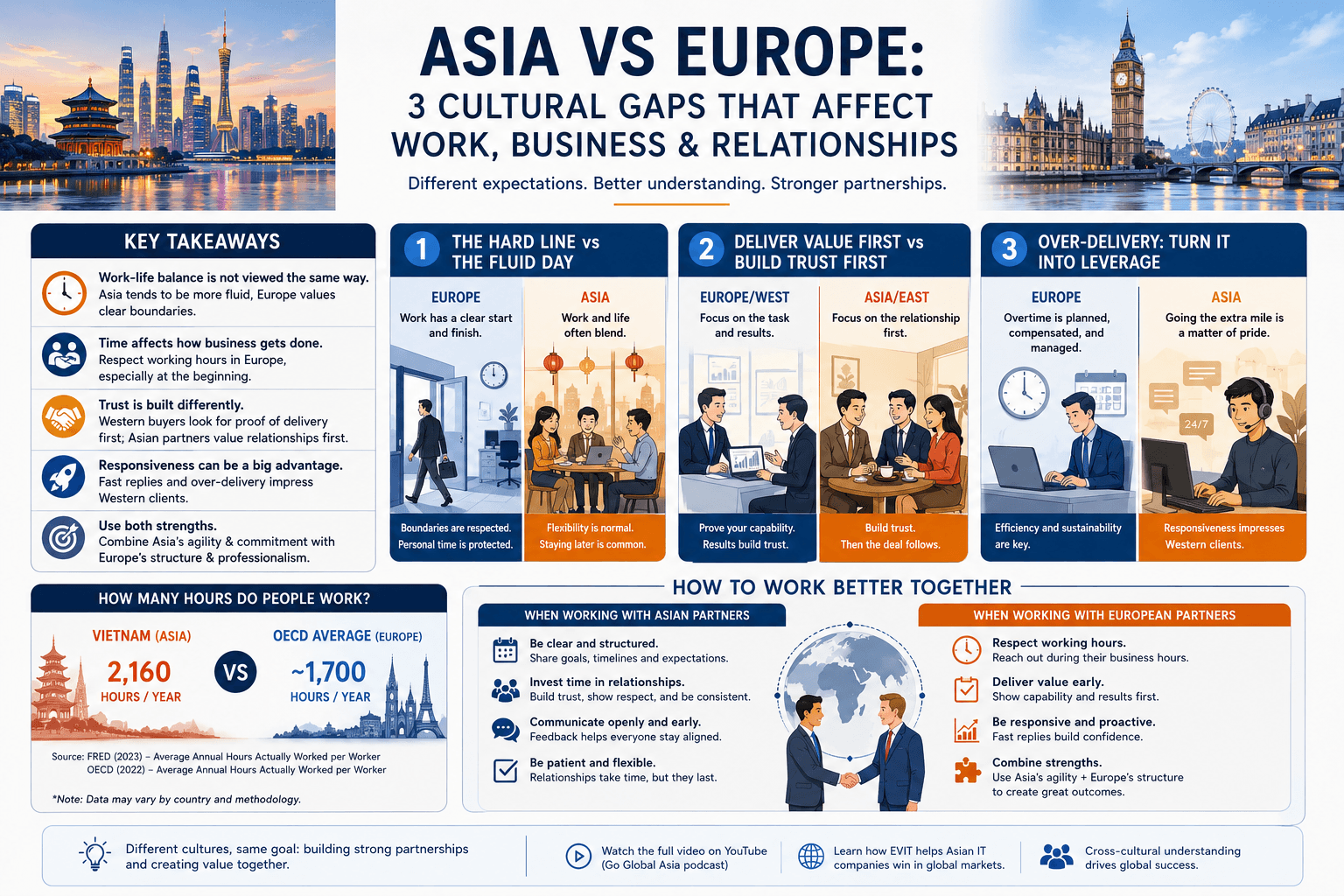

Introduction
In today’s global IT market, price no longer tells the full story. While many Asian IT companies compete on low rates, Western clients are increasingly willing to pay more—not for hours worked, but for value delivered.
Understanding value-based pricing is crucial if your company aims to go global and succeed in high-value market entry across Europe, the US, or Australia. In this guide, we’ll uncover what drives higher pricing in Western markets and how your IT firm can shift from “cost-saving vendor” to “strategic technology partner.”
1. Why Western Clients Pay More
Western businesses don’t just buy services—they buy outcomes. They pay premium prices for IT vendors who deliver measurable results, minimize risk, and integrate seamlessly with their culture and processes.
Key factors influencing higher pay rates include:
-
Trust and reliability: Clients value proven track records and transparent communication.
-
Strategic partnership: Vendors who understand the client’s business goals can justify higher fees.
-
Compliance and quality standards: ISO certifications, GDPR compliance, and data-protection maturity often command a premium.
📖 Read also: From Outsourcing Vendor to Trusted IT Partner: How to Elevate Your Global Brand
2. Why Competing on Price Alone Fails
Price competition is a race to the bottom, as when IT firms only promote cost savings, they inadvertently position themselves as replaceable.
Instead, global clients look for vendors who:
-
Offer long-term ROI, not short-term discounts.
-
Provide expertise and consultation, not just coding hours.
-
Bring process maturity, project management, and cultural understanding.
To go global, your positioning must emphasize outcomes—such as faster delivery, innovation, and strategic impact—not just price tags.
3. The Shift to Value-Based Pricing
Value-based pricing means charging based on the client’s perceived value, not your internal cost. For example, if your solution saves a European client €200,000 per year, charging €50,000 is still excellent value.
How to start:
-
Understand the client’s pain points.
Learn what outcomes matter most—efficiency, speed, compliance, or innovation. -
Quantify your impact.
Use case studies and data (e.g., “reduced development time by 40%”). -
Communicate value clearly.
Replace “$25/hour” with “$X per project for Y% performance gain.”
📊 See related post: Understand Value-Based Pricing: Key Strategies and Benefits
4. How to Build Trust and Command Premium Rates
Western clients reward predictability and partnership. You can raise your perceived value—and pricing power—by:
-
Publishing transparent case studies with measurable outcomes.
-
Developing English communication and consulting skills within your team.
-
Obtaining recognized certifications (ISO, GDPR, SOC 2).
-
Investing in brand storytelling that highlights reliability, not just affordability.
🌐 Join the EVIT IT Community to exchange real-world insights on global expansion, compliance, and client relationships.
👉 Join the IT Community here
5. Turning Value Into Market Entry Advantage
When entering Western markets, positioning your company as a trusted partner—not a “low-cost vendor”—becomes your market entry advantage.
A well-executed value-based pricing strategy:
-
Signals confidence and maturity to global clients.
-
Helps you differentiate from other Asian IT vendors.
-
Builds long-term relationships based on mutual growth.
Instead of asking, “How low can we price this?” — start asking, “What’s this worth to the client?”
Conclusion
Western clients pay more because they see value beyond cost—expertise, reliability, and outcomes. For Asian IT companies ready to go global, adopting value-based pricing isn’t just a financial shift; it’s a strategic transformation.
By aligning your pricing with client value and strengthening your brand credibility, you don’t just enter global markets—you stay there.
✅ Next Step: Revisit your proposals. Replace “hourly rates” with results-driven value statements — and watch your global market entry accelerate.