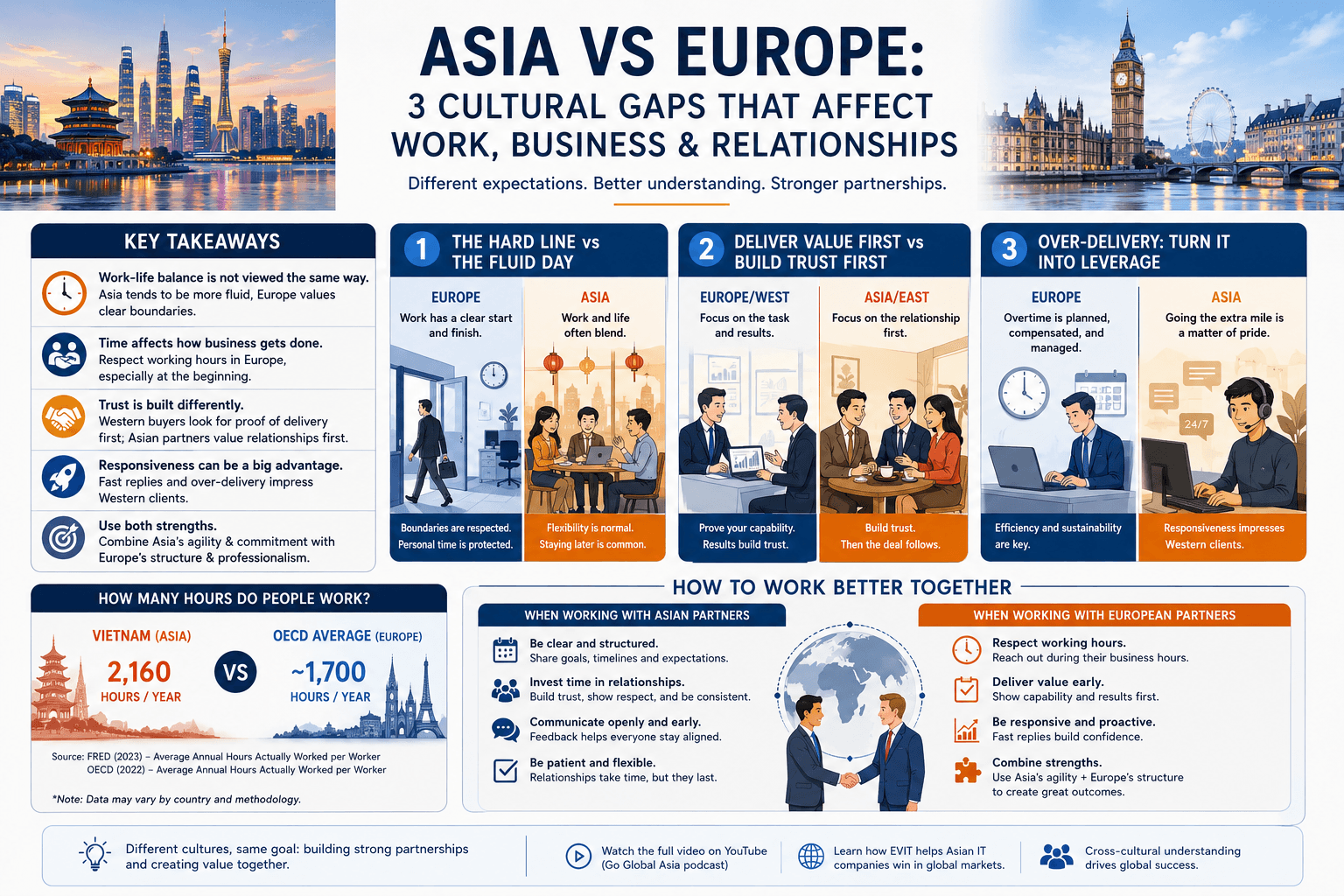
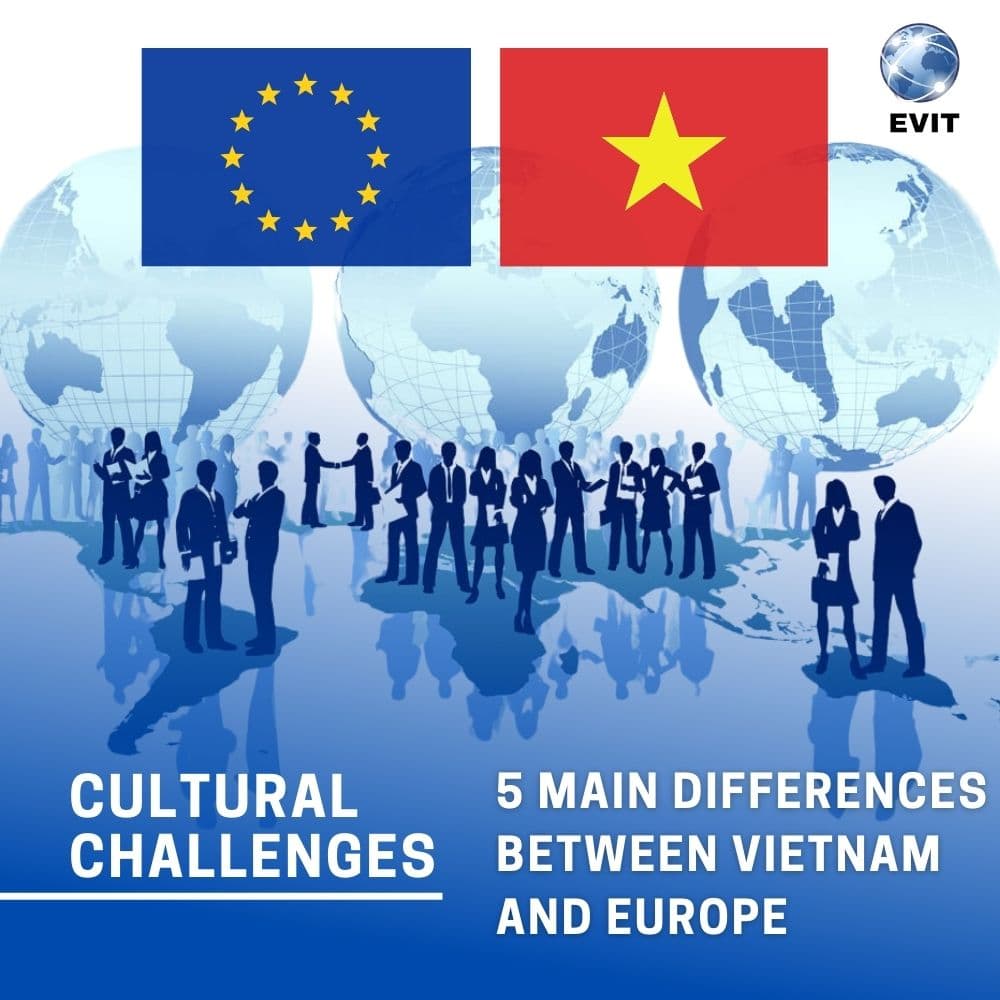
Vietnamese business culture and European business culture differ most in communication style (indirect vs. direct), hierarchy (high vs. low power distance), pace (flexible vs. structured), work-life balance, and decision-making (top-down vs. consensus-driven). Neither approach is wrong, but Western buyers and Vietnamese IT vendors who ignore these gaps in Vietnamese business culture risk delays, misread signals, and lost deals. Bridging them starts with explicit expectations on both sides.
In this blog, we will explore:
- Vietnamese communication is indirect and relationship-first; European communication is direct and fast.
- Vietnam’s Power Distance score (70) is double Germany’s (35) – Vietnamese teams defer more to seniority.
- Vietnam’s Uncertainty Avoidance score (30) is far below Germany’s (65) – Vietnamese teams adapt more freely.
- Vietnamese professionals often work longer hours and see overtime as a sign of commitment.
- Punctuality norms differ – define “on time” explicitly rather than assuming shared expectations

Vietnamese Business Culture vs. European Business Culture: A Practical Guide
As Vietnamese IT service companies scale into Western markets, and as European and North American buyers increasingly outsource development work to Vietnam, understanding Vietnamese business culture has become a commercial necessity, not a soft skill. Misread signals slow down contracts, create friction in delivery, and erode trust that took months to build. Below are the five areas where Vietnamese business culture and European business culture diverge most, along with what each side can do to close the gap.
1. Communication Styles: Direct vs Relationship-First
European business culture, particularly in Germany, the Netherlands, and the Nordics, rewards direct, low-context communication: say what you mean, flag problems early, disagree openly in meetings. Vietnamese business culture is higher-context and relationship-first – concerns are often signaled indirectly, and open disagreement with a client or senior colleague can feel disrespectful. A Vietnamese developer who says “this might be a bit difficult” may mean “this will not work.” Western partners who don’t recognize the cue can be blindsided by delays that were, in fact, flagged weeks earlier.
How to bridge this gap: Vietnamese vendors should adopt structured status reporting that surfaces risks explicitly (red/amber/green flags, written risk logs) rather than relying on verbal hints. European clients should ask direct, specific questions (“What could stop this from shipping on time?”) instead of open-ended ones, and treat hedged language as a signal to dig deeper.
2. Flexibility vs Structure
Vietnam scores just 30 on Hofstede’s Uncertainty Avoidance Index, compared with 65 for Germany (Hofstede Insights Country Comparison Tool), meaning Vietnamese teams are culturally comfortable adapting on the fly, while European teams lean on defined processes, documented scope, and formal change control. This isn’t a competence gap; it’s a preference gap and one of the clearest ways Vietnamese business culture diverges from European norms. Vietnamese flexibility is an asset in agile, fast-moving projects, but it can read as scope creep or under-documentation to a European buyer used to rigid SOWs.
How to bridge this gap: Set a shared documentation standard at kickoff – sprint goals, acceptance criteria, and change-request templates, so Vietnamese adaptability operates inside a framework the European side can audit and trust.
3. Work-Life Balance and Commitment Signals
European professionals generally protect personal time and view long hours as a sign of poor planning, not dedication. Vietnamese professionals, shaped by a culture where visible effort signals loyalty, more often work extended hours and view weekend responsiveness as normal commitment. This can create two failure modes: European clients undervaluing a Vietnamese vendor’s actual effort because it isn’t openly discussed, or Vietnamese teams burning out trying to match perceived European urgency around the clock.
How to bridge this gap: Agree on explicit response-time SLAs and “quiet hours” in the contract, so commitment is demonstrated through delivery and agreed availability windows, not assumed based on either side’s default norms.
4. Time Management and Scheduling Norms
Punctuality is treated as a hard professional signal in most of Europe — five minutes late can register as disrespect. Vietnamese business culture treats time more elastically, especially around meeting start times and informal scheduling, without intending any disrespect. Combined with time-zone gaps between Vietnam and Western Europe (6-7 hours) or North America (11-14 hours), small scheduling misalignments compound quickly across a project timeline.
How to bridge this gap: Confirm meeting times in writing with time zone and buffer explicitly stated, and build a standing weekly sync into every engagement rather than relying on ad hoc scheduling.
5. Decision-Making: Consensus vs Hierarchical Approval
Vietnam’s Power Distance score of 70 sits well above Germany’s 35 and most Western European countries (Hofstede Insights AHK Vietnam), reflecting a culture where authority and seniority carry strong deference. Vietnamese teams typically escalate decisions upward and expect leadership to have final say after gathering input, while many European organizations favor flatter, consensus-driven decision-making where any team member can push back. Western buyers negotiating directly with junior Vietnamese staff may get slower or noncommittal answers, not from evasiveness, but because the real decision-maker hasn’t weighed in yet.
How to bridge this gap: Identify the actual decision-maker on the Vietnamese side early, and involve them directly in scoping calls rather than routing key decisions through junior points of contact.
FAQs: Vietnamese Business Culture vs European Norms
What Defines Vietnamese Business Culture Compared to European Norms?
The five biggest differences are communication style (indirect vs. direct), hierarchy and decision-making (top-down vs. consensus), tolerance for ambiguity (flexible vs. structured), attitudes toward work-life balance, and norms around punctuality and scheduling. Understanding Vietnamese business culture on these points prevents miscommunication and builds smoother, faster-moving partnerships.
How Do Vietnamese IT Teams Communicate Differently Than European Clients?
Vietnamese teams tend to communicate indirectly, prioritizing relationship harmony and softened language over blunt disagreement. European clients typically expect direct, explicit flagging of risks and problems. Structured status reports and direct questioning help both sides communicate clearly without cultural friction.
Despite These Gaps, Is Vietnamese Business Culture Still Outsourcing-Friendly?
Yes. The gaps between Vietnamese business culture and European norms are manageable with the right processes clear documentation, defined decision-makers, and explicit SLAs. Combined with strong technical talent and competitive costs, Vietnam remains one of the most attractive outsourcing destinations for Western companies when cultural alignment is actively managed.
How Should Western Companies Build Trust With Vietnamese IT Vendors?
Build trust by identifying the real decision-maker early, communicating expectations explicitly rather than assuming shared norms, and giving consistent, direct feedback. Regular video calls and in-person visits also accelerate trust faster than email-only relationships, given how relationship-first Vietnamese business culture tends to be.
Do Vietnamese Teams Work Different Hours or Have Different Time-Zone Expectations Than European Teams?
Vietnamese professionals often work longer hours and respond outside standard business hours more readily than European counterparts. Combined with a 6-7 hour time difference from Western Europe, successful partnerships require agreed overlap windows and explicit response-time expectations set in the contract.
Sources: