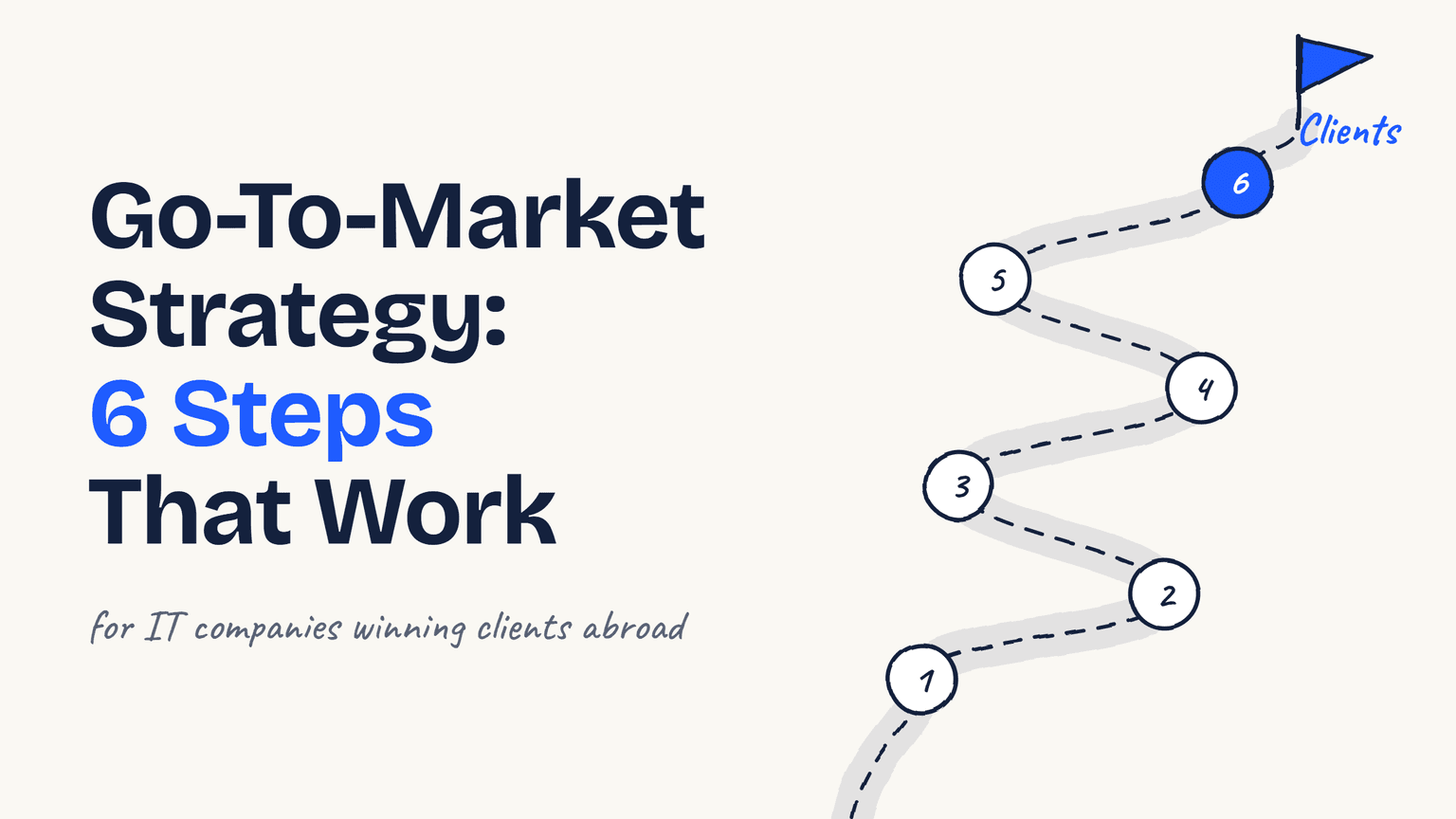
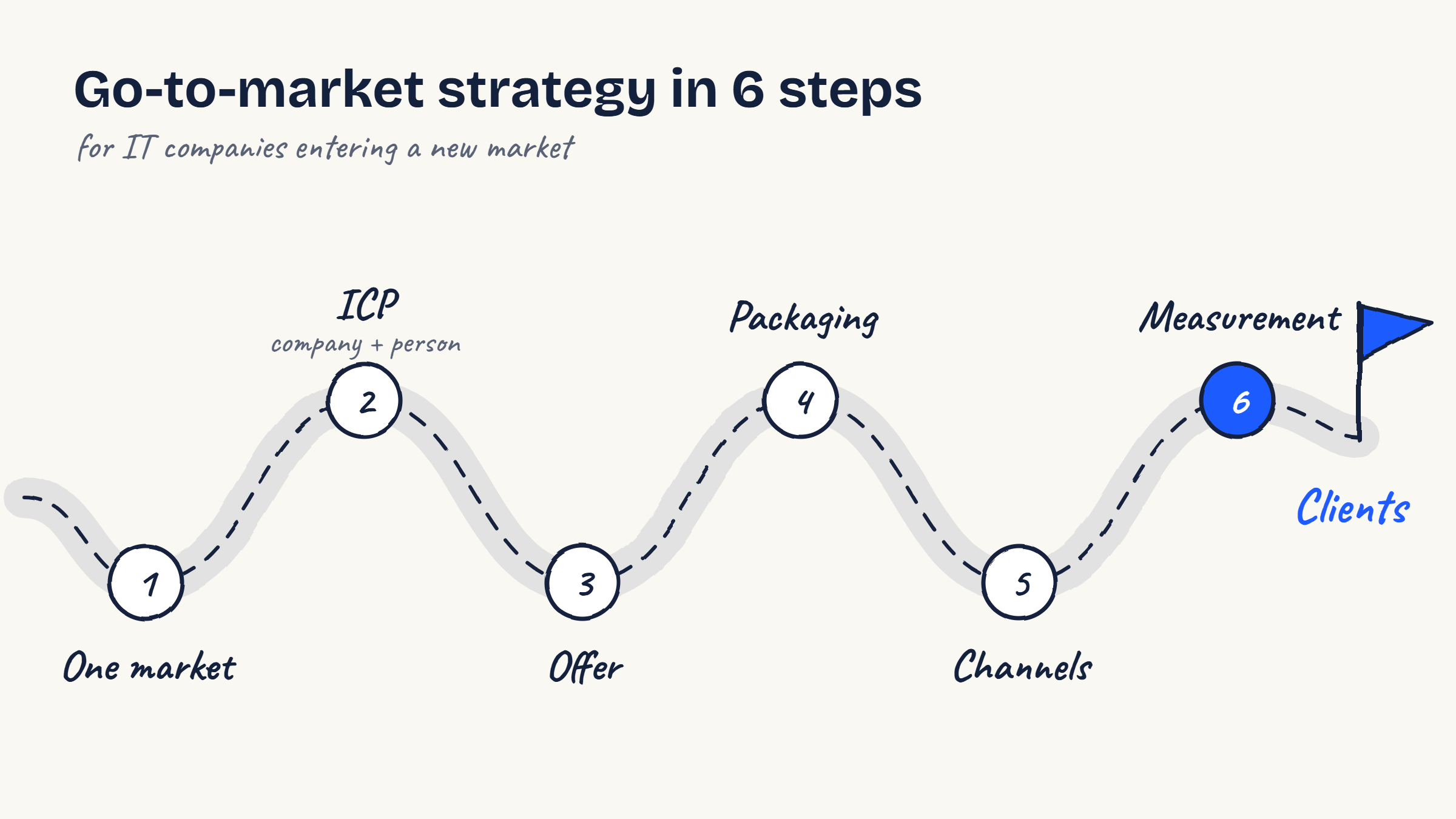
Give me 10 minutes, and I will give you a go-to-market strategy that actually brings clients. Not a theory deck: 6 steps, in order.
If you run an IT company and you have been saying “we need to go international” for a year, but you are still waiting on referrals, this guide is for you. For 7 years, I have done one thing: helping Asian IT companies win clients abroad.
For example, our client, NKK Tech, came to us at the very start of their international journey. Both had strong engineering teams and wanted to put more of that talent to work on projects abroad. Together, we picked one market, the US, and built exactly the plan I will show you below. Today, both teams are winning more business.
Prefer video? Watch the full breakdown: Give Me 10 Minutes, I’ll Give You a GTM That Brings Clients.
By Adam Skoneczny: CEO at EVIT Consulting – 20+ years in international business
Key Takeaways: Go-To-Market Strategy in 60 Seconds
- Choose your market: the one where you already have case studies.
- Build your ideal client profile in 2 parts: the company and the person.
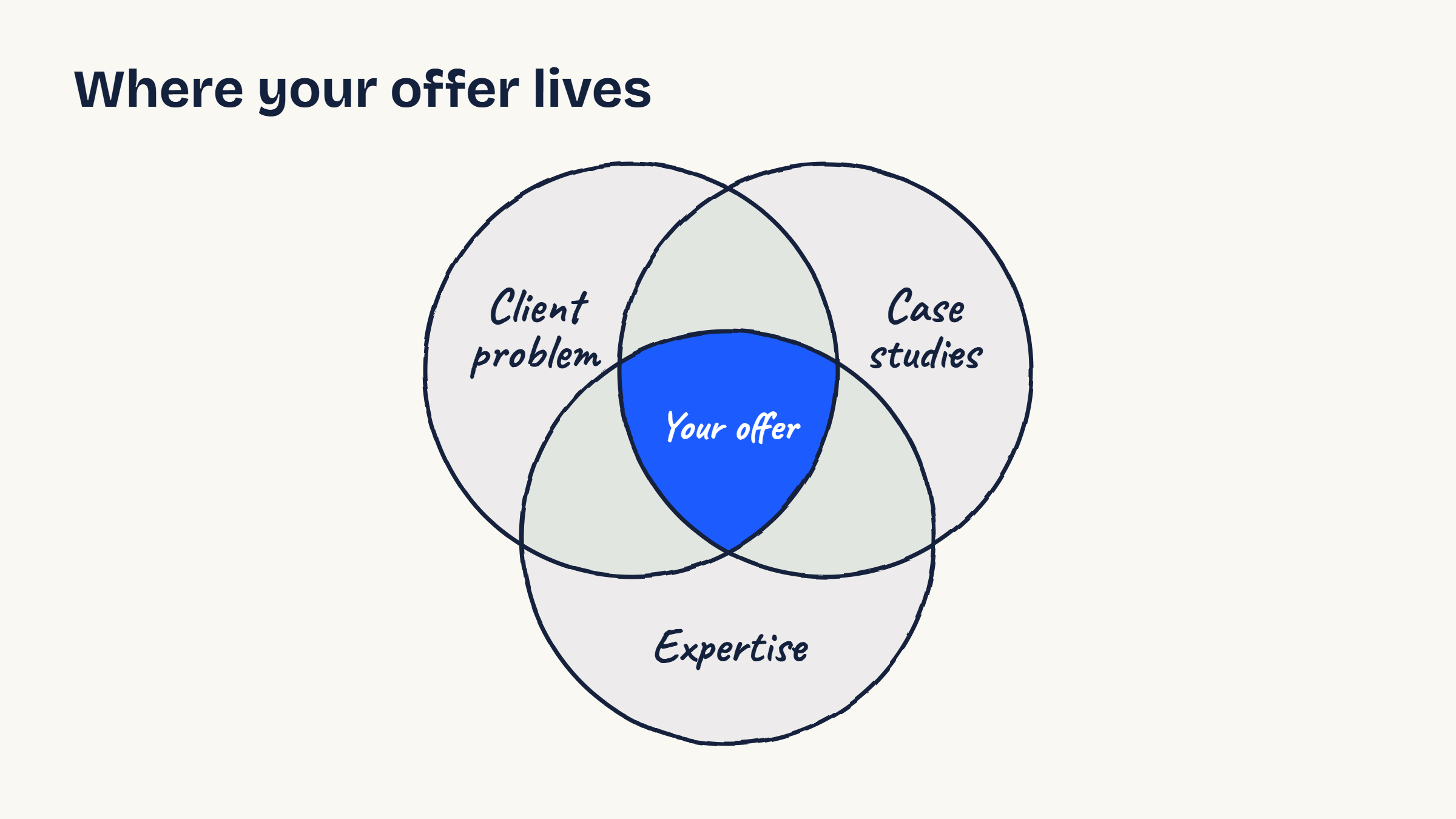
- Your offer sits where 3 things overlap: the client’s problem, your case studies and your expertise.
- Package it against 4 tests: simplicity, guarantee, result and effort.
- Let your client profile pick the channels, then measure on 3 levels: individual, group and pipeline.
Why Most IT Companies Have NO GMT Strategy
Most IT companies grow on referrals. That works, until it stops. Then the founder says “we need to go international” and starts doing everything at once.
Meanwhile, buyers have changed. According to 6sense’s 2024 Buyer Experience Report, buyers are about 70% through their buying process before they talk to a vendor. Moreover, 84% already had experience with the vendor they finally chose. In other words, buyers pick vendors they already trust. Without a plan for earning that trust, you never make the shortlist.
Old vs New Go-To-Market Strategy for IT Companies
| Old way | New way | |
|---|---|---|
| Market | US, UK, Germany, Australia, all at once | 1 market, where you already have proof |
| Client profile | “Any company that needs software” | Company profile + person profile |
| Offer | A menu: web, mobile, AI, cloud, QA, DevOps | One offer built on the client’s main problem |
| Channels | Whatever the founder likes | Wherever the client’s decision-maker spends time |
| Results | “We’re busy” | Measured on 3 levels and adjusted |
Strategy #1: Choose One Market
Step one: choose one market. One, maximum.
I know you want the US, the UK, Germany and Australia all at once. Almost every founder I meet wants that. However, here is what happens: your team, your budget and your attention get split five ways. As a result, nobody in any of those markets sees enough of you to trust you.
How to Pick the Right Market for Your Go-To-Market Strategy
The rule is simple: go where you already have case studies, references and testimonials. If you have delivered 3 projects for clients in Germany, Germany is your market. Not because it is the biggest, but because that is where you have proof.
Proof is exactly what buyers look for. In Forrester’s research, 71% of business technology buyers rated customer, industry or peer case studies as highly valuable content. Similarly, buyers in Responsive’s 2025 survey named industry expertise among the top factors when selecting a vendor.
Quick exercise: count your case studies by country right now. Which country wins? That is your market.
Strategy #2: Build a Two-Part Ideal Client Profile
Step two is your ideal client profile (ICP). Again, keep it simple and build it from your past clients. Who did you deliver great work for? Who paid on time? Who came back for more? That is your pattern.
Company vs Person: Why You Need Both
Here is the catch most people miss: your ICP has 2 parts with different criteria.
- The company: industry, size, location, and what is happening inside that business.
- The person: the human who reads your email and says yes or no. Think about their role, what they care about and what keeps them up at night.
Perfect company, wrong person: you get ignored. Right person, wrong company: there is no budget. You need both. This matters even more because Gartner finds a typical buying group for a complex B2B solution involves 6 to 10 decision-makers.
Finally, write down the client’s main problem in your profile. Hold on to it, because step three is built on it. We have templates for both the company profile and the person profile; just ask for them when you book a free consultation.
Strategy #3: Turn Services Into an Offer
Step three: what are you actually selling? Most IT companies answer with a list: “We do web, mobile, AI, cloud, QA, DevOps.” That is a menu, not an offer.
Instead, your offer comes from 3 places:
- The problem you wrote in your client profile.
- Your past case studies, or what you have already proven you can solve.
- Your expertise, or what your team is genuinely great at.
Where those three overlap, that is your offer. Above all, it must be built around solving the client’s main problem, not your favourite technology.
Strategy #4: Package It So Clients Say Yes
This is where many good companies lose deals they should win. The same service, packaged badly, does not sell. Packaged well, it becomes attractive.
The 4-Point Packaging Checklist
- Simplicity: can the client understand it in one sentence? If you need a 20-page proposal to explain it, it is too complicated.
- Guarantee: what are you putting on the line? For example, we guarantee a level of qualified pipeline, or we keep working for free. That takes the risk off the client.
- Result: sell the outcome, not the hours. Nobody wakes up wanting “two senior developers”; they want the product launched.
- Effort: how much does the client have to do? The less effort on their side, the easier the yes.
Now check your current offer against these 4 points. Which one is the weakest?
Strategy #5: Let Your Client Choose the Channels
This step is where I see the most money wasted. Not because people pick a bad channel, but because they pick it for the wrong reason.
Here is what nobody tells you: you do not choose the channel; your client profile does. Go back to your person profile. Where is this person, online and offline? A CTO in Germany and a founder in Australia do not spend time in the same places.
For instance, if your buyer is on LinkedIn every morning, go there; LinkedIn reports that 4 out of 5 of its members drive business decisions. On the other hand, if they ignore everything except 2 trade shows a year, go to those shows. According to CEIR, 81% of trade show attendees have buying authority.
The mistake I see all the time is choosing LinkedIn because the founder likes LinkedIn, or cold email because it is cheap. That is choosing for yourself, not for the client. We keep a map of 20 to 30 channels, from WhatsApp and cold calling to email, trade shows, branding and marketing. Our B2B marketing and lead generation service helps you pick and run the right ones.
Strategy #6: Measure on 3 Levels
If you do not measure it, you are just busy. So measure on 3 levels:
- Individual outreach: your one-to-one messages, calls and conversations.
- Group outreach: your campaigns, sequences and events.
- Pipeline: what happens after the first meeting, such as proposals, deals and signed contracts.
Each level has its own criteria and conversion rates. I will not give you magic numbers here, because they must be set for your industry and your client profile. What matters is that you track all 3 levels and adjust. Our G.O.D. Sales System shows you how to set these targets and train your team to hit them.
The “Missing” Step in This Go-To-Market Strategy
I left one step out on purpose: market research. Actually, it is not missing; it is built in. In step one, you chose the market where you already have case studies. That means you already understand it. You have delivered there, and you know how those clients think. That is your research.
So here is the whole plan: one market, a two-part client profile, an offer built on the client’s problem, and packaging that is simple, guaranteed, results-focused and low effort. Then channels chosen by your client, and measurement on 3 levels. This is the same foundation NKK Tech built on when they started selling internationally, and it works just as well from a standing start. For a full market-entry plan, see our Growth & Market Entry Consulting.
Go-To-Market Strategy 2026: Key Numbers at a Glance
| Number | What it means | Source |
|---|---|---|
| 6 | Steps in this go-to-market plan | EVIT |
| 1 | Market to start with | EVIT |
| 6-10 | Decision-makers in a complex B2B purchase | Gartner |
| 70% | Share of the buying process done before talking to a vendor | 6sense, 2024 |
| 84% | Buyers who already had experience with the vendor they chose | 6sense, 2024 |
| 71% | Tech buyers who rate case studies as highly valuable | Forrester |
| 4 of 5 | LinkedIn members who drive business decisions | |
| 81% | Trade show attendees with buying authority | CEIR |
| 20-30 | Channels on EVIT’s channel map | EVIT |
| 3 | Measurement levels: individual, group, pipeline | EVIT |
FAQ: Go-To-Market Strategy
What is a go-to-market strategy for an IT company?
It is the plan for how you win clients in a specific market. Ours has 6 steps: one market, a two-part ICP, an offer, packaging, channels and measurement. Each step builds on the one before it.
How long does it take to see results?
It depends on your market and offer, but you usually see first signals within weeks if you execute consistently every week. For example, one client set up client calls in 3 weeks using our method, as shown in our case studies.
Which channels work best in a go-to-market strategy?
The ones your buyer actually uses. LinkedIn suits many tech decision-makers, since 4 out of 5 members drive business decisions. However, if your buyers live at trade shows, where 81% of attendees have buying authority, go there instead.
Get Your Go-To-Market Strategy Built
Want to see how these 6 steps turn into a full plan? Watch “The Million Dollar Plan” on Adam’s YouTube channel, or book a free consultation and ask for our ICP templates and channel map.
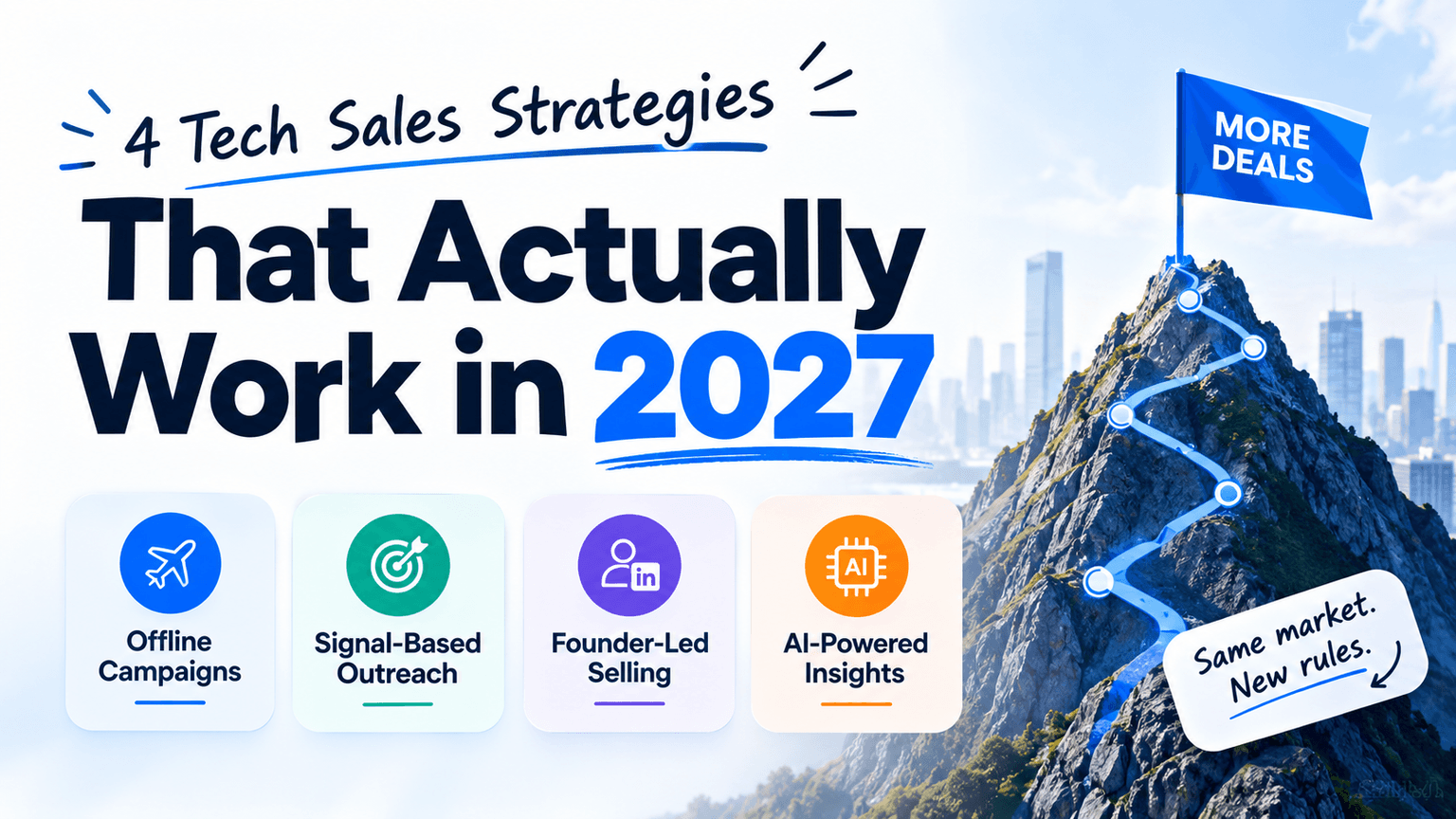
For more practical guides, read our posts on tech sales strategies and Vietnam business costs, or browse the EVIT blog.